Connected context
Bring together structured data, clinical evidence, terminology, and domain relationships in one knowledge foundation.

A domain-specific foundation for Life Sciences AI Agents—connecting source data, clinical evidence, and regulatory rules to generated content.
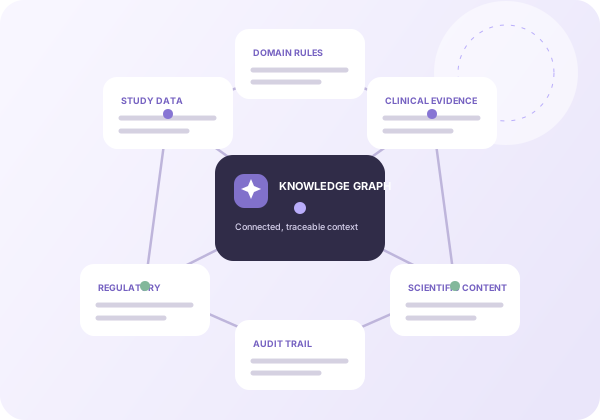
The Narrativa Knowledge Graph is a structured, domain-specific repository at the heart of Navigator. For Life Sciences AI Agents, it connects clinical-trial data, safety evidence, product information, terminology, and regulatory rules to help ground generated content in its source context.
Combined with data analytics, Natural Language Generation, and agentic AI, it helps medical writers and regulatory teams create consistent drafts that are easier to trace, understand, and review.
Use validated information and domain-specific context to guide generated content, support compliance review, and adapt to changing requirements.
Bring together structured data, clinical evidence, terminology, and domain relationships in one knowledge foundation.
Link generated statements back to source data, making content easier to explain, check, and audit.
Update industry-specific or client-defined rules, document structure, and formatting without retraining models.
Large Language Models help with data processing and natural language generation. The Knowledge Graph adds structured clinical and regulatory context, helping guide Life Sciences AI Agents toward relevant facts, source evidence, and document requirements.
See how this foundation supports Medical Authoring Companion and Clinical Study Report automation.
LLMs assist with ETL tasks and data enhancement, surfacing useful information from structured datasets.
LLMs handle phrasing, word choice, and contextual language to make generated content clear and readable.
Knowledge Graph data and domain rules shape prompts for the task, rather than relying on static, one-size-fits-all instructions.
Combining language generation with connected evidence supports consistency, traceability, and regulatory or editorial review.
Work across document and data sources, then keep the knowledge base current as your business and content needs grow.
Use PDFs, Word documents, spreadsheets, and other business information as inputs to organized content workflows.
Update data and domain rules as requirements change, without rebuilding or retraining the underlying models.
Use self-hosted open-source models for sensitive data while maintaining control over how information is handled.
See how the Knowledge Graph can connect your data, rules, and content workflows.
Talk to our team ↗At the heart of the Narrativa Navigator platform is the Narrativa Knowledge Graph, a structured, domain-specific repository that powers precise and explainable content generation.
This unique foundation combines advanced data analytics, traditional Natural Language Generation (NLG), and state-of-the-art agentic AI to deliver content that is accurate, scalable, and fully traceable.
Narrativa integrates Large Language Models (LLMs) throughout both data processing and content generation phases to enhance automation with precision and intelligence. On their own, LLMs offer strong linguistic capabilities—but when paired with the Narrativa Knowledge Graph, they become far more powerful and reliable.
During data processing, LLMs assist with ETL tasks and data enhancement, deriving new insights from structured datasets and improving downstream content quality. In the text generation phase, they resolve nuanced language tasks like verb selection, synonym use, pluralization, and contextual phrasing to produce natural, human-like text.
What makes this system exceptional is Dynamic Prompt Generation powered by our Knowledge Graph. Instead of relying on static, one-size-fits-all prompts, Narrativa dynamically builds precision-targeted prompts based on structured data and domain-specific rules. This ensures that the LLM produces output that is not only fluent, but also factually correct and compliant.
This synergy of Knowledge Graph and LLMs eliminates hallucinations, improves consistency, and ensures outputs meet regulatory and editorial standards—making it a robust foundation for scalable, enterprise-grade content automation.
Narrativa makes it easy to turn scattered, unstructured business data into organized ready-to-publish content.
Narrativa works with a wide range of file types, including PDFs, Word documents, spreadsheets, and others. As your business grows, our solution grows with you, supporting continuous updates and easy scaling, keeping your content accurate, current, and ready for automation.
The Wall Street Journal, one of the most influential newspapers in the world, is now using Narrativa’s Natural Language Generation (NLG) services to automate its news. Alyssa Zeisler, R&D editor at The Wall Street Journal, recently revealed on Medium how they use our artificial intelligence system and the benefits this brings to their digital strategy.
Alyssa Zeisler