




Narrative Pathway

Automate Patient Safety Narrative Authoring with AI Agents

Narrative Pathway applies AI Agents to generate patient narratives directly from structured clinical data, ensuring scalability, traceability, and regulatory compliance.

Automate Patient Safety Reports with AI Agents

With advanced AI Agents, Narrative Pathway streamlines the creation of patient narratives clinical study report deliverables—using specialized AI Agents for patient narrative generation and exclusion/inclusion criteria drafting to transform structured clinical data into submission-ready narratives—reducing manual effort while improving accuracy, consistency, and speed across safety narratives.

Key Benefits of Narratives AI Automation

Success Story

A top pharmaceutical company used Narrativa’s AI Agents to automate patient safety narratives and clinical reports, reducing manual effort, ensuring compliance, and accelerating regulatory submissions all while achieving 100% data accuracy.

A Smarter Safety Narrative Writing Tool

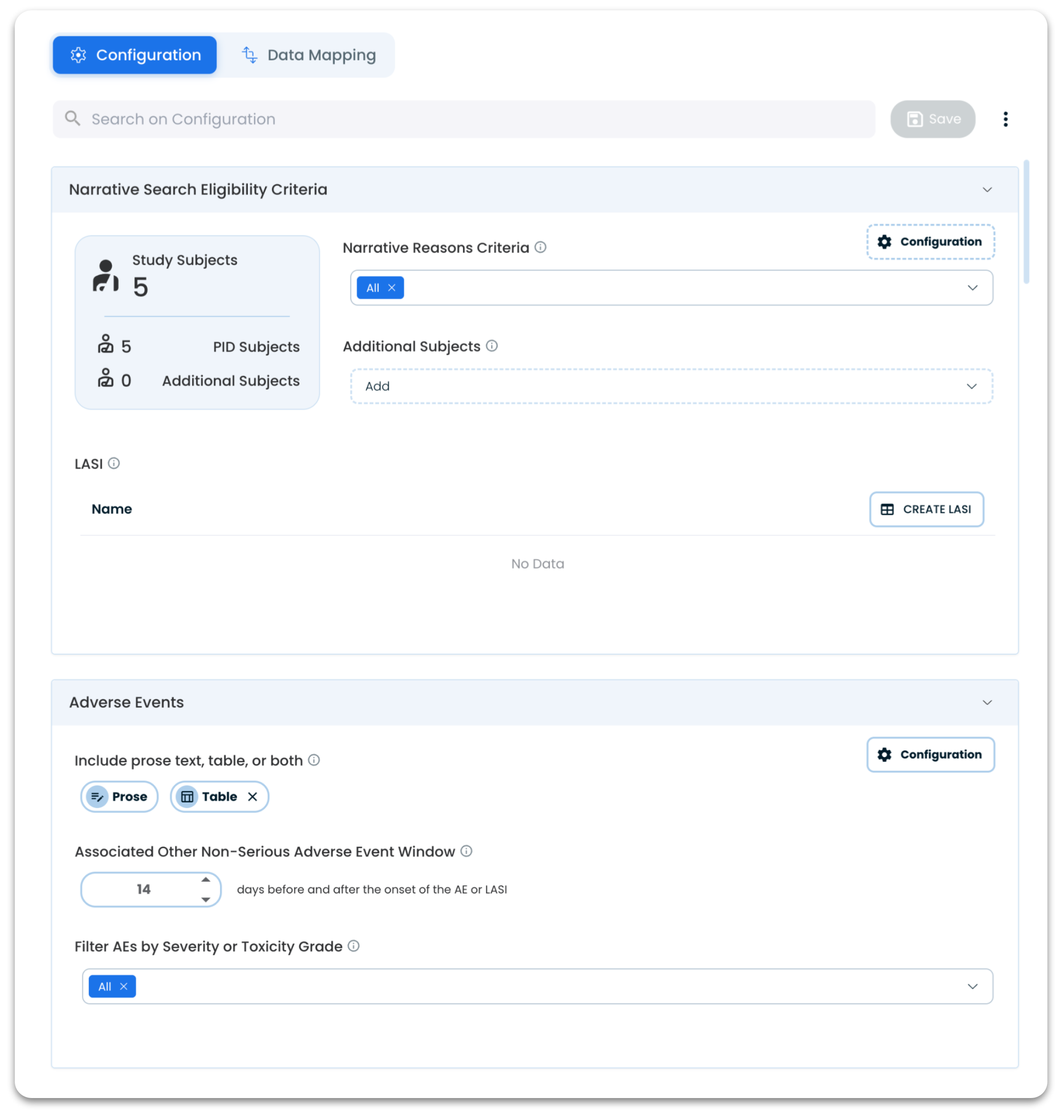
Narrative Pathway solution provides a highly configurable framework that enables users to tailor both the content and structure of patient narratives to specific study, sponsor, or regulatory requirements. It allows precise control over which patients are included, based on eligibility and narrative criteria, and how each section of the narrative is generated. Key clinical domains—such as demographics, adverse events, treatments, medical history, laboratory data, and vital signs—can all be independently configured, including whether the output is presented as prose, tables, or a combination of both.

A defining strength of Narrative Pathway is its ability to apply granular filtering and time-based logic across datasets. Users can define windows around key clinical events (such as adverse event onset or treatment exposure), filter data by severity or category, and control exactly which observations are included in each section. This ensures narratives are consistent, compliant, and clinically meaningful, while still flexible enough to meet different reporting standards.
Fully configurable

AI Agents transform clinical data into compliant, submission-ready narratives.

Key configurable capabilities

✓ Narrative Reason Criteria Built-in functionality

Adjustable time windows based on onset of AE or LASI events

✓ Adverse event, and LASI inclusion criteria

✓ Treatment and medical history customization

✓ Concomitant and non-drug treatments inclusion/exclusion criteria

✓ Laboratory, vital signs, and ECG data, with baseline inclusion and event-based filtering

More about Patient Narratives Automation

Patient safety narratives are essential components of clinical study reports, summarizing adverse events and supporting the evaluation of drug safety across all phases of clinical trials. These narratives establish the relationship between adverse events and investigational treatments and are required for regulatory submissions such as Marketing Authorization Applications (MAA).

Traditionally, generating these narratives has been a highly manual and resource-intensive process. Medical writers must review multiple data sources—such as CRFs, CIOMS forms, MedWatch reports, and clinical listings—to compile each narrative. This approach becomes increasingly complex and time-consuming in large-scale studies, often leading to bottlenecks, inconsistencies, and increased risk of errors.

With the emergence of agentic AI, patient narrative generation is evolving from manual drafting to intelligent, automated workflows. AI Agents can interpret structured clinical data, apply standardized medical reasoning, and generate high-quality, submission-ready narratives at scale.

Unlike traditional automation, AI Agents go beyond simple data transformation—they can contextualize clinical information, ensure consistency across thousands of patients, and support complex regulatory requirements. This shift enables medical writers to move from manual authoring to review and validation roles, significantly improving productivity and output quality.

Modern narrative automation solutions support the full lifecycle of patient safety reporting:

Data ingestion: Extracting and harmonizing data from CRFs, listings, and safety forms
Narrative generation: Automatically drafting structured, compliant narratives
Quality control: Identifying inconsistencies, missing data, and conflicts
Review and refinement: Enabling human-in-the-loop validation and edits
Batch delivery: Generating large volumes of narratives for submission

By leveraging a single source of truth, automation ensures consistency between narratives and underlying datasets, reducing discrepancies and rework during review cycles.

As clinical trials grow in size and complexity, the number of required safety narratives can reach thousands. AI-driven automation enables scalable narrative generation, allowing teams to handle large patient populations efficiently without compromising quality or compliance.

This is particularly critical in late-phase trials and studies involving chronic or complex conditions, where timelines are tight and reporting requirements are extensive. Automation helps organizations meet regulatory deadlines while maintaining high standards of accuracy and traceability.

AI-powered narrative automation improves not only speed but also quality:

Consistency: Standardized outputs across all patients and studies
Accuracy: Direct data extraction reduces manual transcription errors
Traceability: Clear linkage between source data and generated text
Compliance: Built-in alignment with regulatory expectations

AI systems can also support advanced quality checks, identifying discrepancies in timelines, adverse event descriptions, or missing clinical details before submission—reducing the burden on manual QC processes.