
NARRATIVA PATHWAY · CUSTOMER STORY
Blood Cancer United
More time for research. More hope for patients.
How Blood Cancer United uses AI-powered patient narratives to give medical writers more time for the work—and the people—that matter.
Organization Blood Cancer UnitedWork Safety narratives, CSRs & TLFsSolution Narrativa Navigator


CUSTOMER-REPORTED RESULTS
More capacity for patient impact.
Narrativa’s agentic AI solutions help Blood Cancer United accelerate patient narrative authoring, improve consistency, and direct more resources toward trials and cures.
reported
reported
reported
reported
Average project cost savings ranged from 54–68%. Narrative consistency reached 99%, compared with 68% using the manual approach.
THE PROBLEM
A growing workload. A mission that cannot wait.
Blood Cancer United (formerly The Leukemia & Lymphoma Society) is a nonprofit organization dedicated to finding cures and ensuring access to treatments for people with blood cancer. Founded in 1949, it has grown into one of the largest voluntary health organizations in the United States.
The organization funds research, supports patients and families, and advocates for policies that benefit people affected by blood cancer. It needed to bring that support to patients sooner and more effectively.
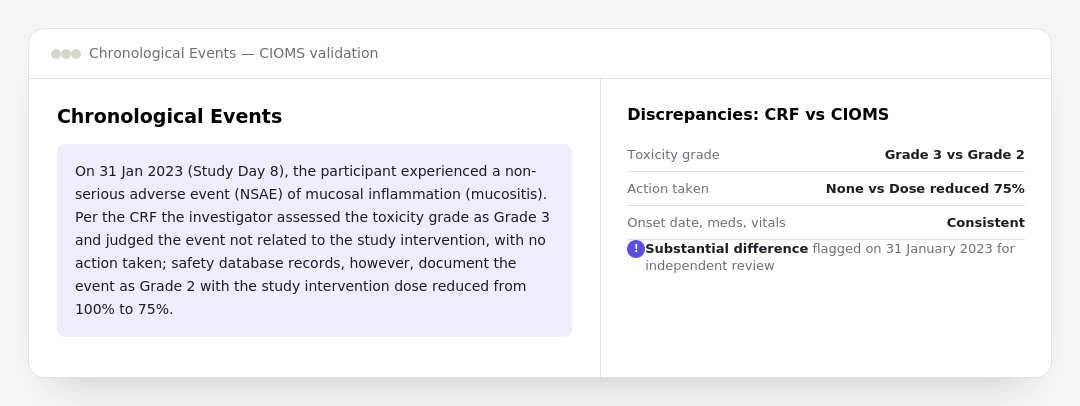
High narrative volumes made it difficult for medical writing teams to deliver patient safety narratives on time. The quality and consistency of manually authored narratives fell below organizational standards as the workload grew.
Patient safety narratives require writers to analyze clinical data, identify safety signals, and clearly communicate adverse events. Doing this accurately and consistently across growing datasets takes substantial expert time.
THE SOLUTION
Automate the authoring. Keep experts in control.
With Narrativa Navigator, Blood Cancer United is automating patient safety narrative reports and large portions of clinical study reports and tables, listings, and figures—while medical writers retain oversight.
Bring in study data
Use clinical safety datasets as the basis for accurate, structured patient narratives.
Automate narrative drafts
Generate patient safety narratives and support other regulatory documentation at scale.
Focus expert review
Free medical writers to perform deeper quality control and support complex work.
THE KPIS
How success was measured.
Time savings
Tracked time spent on data analysis, narrative authoring, and review and editing before and after implementation.
Cost savings
Assessed the resource costs associated with patient narrative projects; project cost savings ranged from 54–68% on average.
Quality and accuracy
Compared AI-generated and manually drafted narratives with a scoring system for clarity and accuracy. Initial-draft quality improved by an average of 83%.
Consistency
Validated standardized presentation against prespecified templates through independent audits and scoring; consistency measured 99% versus 68% manually.
THE OUTCOME
More resources for research and cures.
Automating narrative creation improved efficiency, quality, and consistency while reducing writer time and data discrepancies. Starting implementation before database lock helped mitigate risk and gave writers more time for deeper quality control. Blood Cancer United also cited the solution’s potential to scale across its work.
“Medical writing automation ultimately allocates more funding toward actual trials and finding more cures for patients.”Len Rosenberg · Head of Clinical Operations, BCU BAML