AI Agent for regulatory content validation
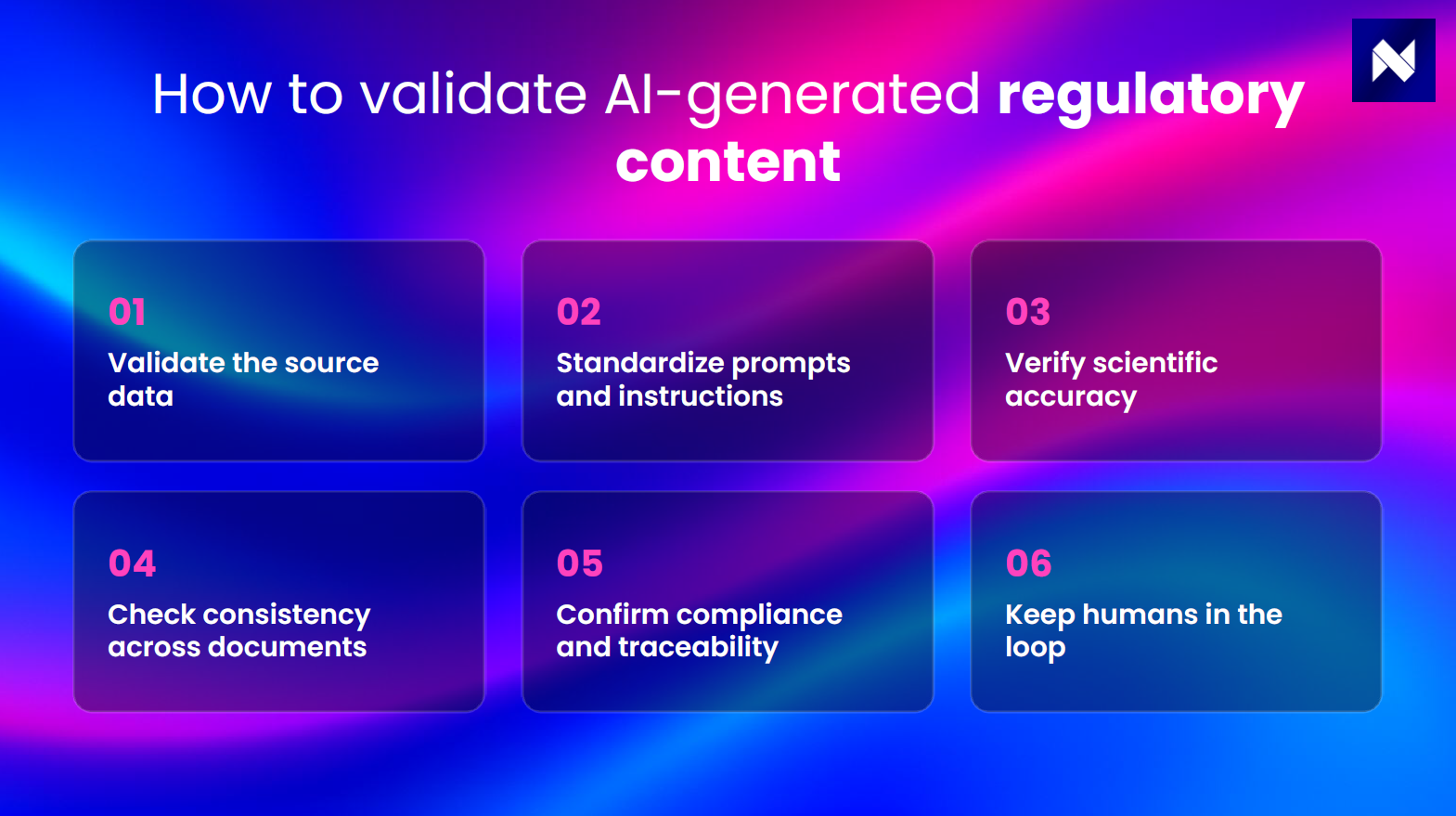
How to validate AI-generated regulatory content
Narrativa’s Regulatory Content Validation Agent reviews regulatory documents against approved source data, predefined requirements, and related content. It identifies potential inaccuracies, inconsistencies, missing information, and unsupported statements while keeping regulatory experts in control of final approval.
Validate regulatory content with confidence
Artificial intelligence is transforming regulatory affairs. Pharmaceutical, biotech, CRO, and medical device companies are using AI to draft clinical study reports, patient narratives, investigator brochures, and other regulatory documents faster than ever before.
However, generating content is only part of the equation. The real challenge is ensuring that every document is accurate, traceable, compliant, and suitable for regulatory review.
The Regulatory Content Validation Agent integrates validation into the content workflow, helping life sciences organizations review growing document volumes without making manual quality control the new bottleneck.
What does the Regulatory Content Validation Agent validate?
The agent helps determine whether AI-generated and human authored regulatory content is reliable, consistent, and fit for its intended use. Its role goes beyond proofreading the final document.
It supports teams by checking that:
- Content is based on approved and verified source data.
- Scientific statements accurately reflect the underlying evidence.
- Documents follow regulatory and company requirements.
- Information remains consistent across related documents.
- Statements can be traced back to their sources.
- Human experts review and approve the final content.
The objective is not to assume that AI is perfect. It is to create a controlled process that consistently produces trustworthy regulatory documentation.
How the Regulatory Content Validation Agent works
1. Validates source data
The agent works with approved clinical datasets, protocols, statistical outputs, and validated reference documents. Generated statements remain connected to their original sources.
2. Applies standardized instructions
Approved prompts, templates, terminology, and validation rules help ensure consistent structure, language, and review criteria across studies and teams.
3. Verifies scientific accuracy
The agent checks numerical values, statistical interpretations, efficacy and safety statements, endpoints, and protocol alignment against the underlying evidence.
4. Checks consistency across documents
It compares information across CSRs, patient narratives, summaries, protocols, and other submission documents to identify conflicting values, terminology, or conclusions.
5. Confirms completeness and traceability
The agent identifies missing information, absent references, unsupported statements, and content that does not meet predefined requirements. Findings remain connected to their supporting sources.
6. Presents findings for human review
Potential issues are highlighted for medical writers, regulatory professionals, and subject matter experts. Qualified professionals retain responsibility for resolving findings and approving the final document:
- Numerical values that do not match source data.
- Unsupported scientific or regulatory statements.
- Inconsistencies between sections or related documents.
- Missing information or references.
- Incorrect or inconsistent terminology.
- Misalignment with protocols, endpoints, or statistical outputs.
- Deviations from approved templates and content requirements.
- Statements that cannot be traced to an approved source.
Regulatory documents it can review
- Clinical study reports
- Patient narratives
- Clinical study protocols
- Investigator brochures
- Safety and efficacy summaries
- Regulatory submission documents
- Documents included within eCTD submissions
- Other clinical and regulatory content

Key benefits
Faster review cycles
Automate repetitive quality checks and direct reviewers toward findings that require expert attention.
Improved scientific accuracy
Compare content with approved evidence before it progresses through the approval workflow.
Greater consistency
Identify discrepancies across sections, documents, studies, and submission materials.
Complete traceability
Connect findings and statements to their supporting sources.
Scalable quality control
Apply consistent review criteria across large document volumes.
Human oversight
Keep qualified regulatory and medical writing professionals in control of final decisions and approval.
Built for regulated life sciences workflows
The Regulatory Content Validation Agent operates within Narrativa® Navigator, our agentic AI platform for regulated life sciences environments.
Narrativa combines controlled data sources, standardized workflows, source traceability, audit trails, version management, role-based access, and human oversight. This enables pharmaceutical, biotech, and CRO teams to scale regulatory content production while maintaining quality, consistency, and transparency.
The agent supports content validation and expert review. It does not replace formal computerized system validation, organizational quality procedures, or final approval by qualified professionals.