Scan documents at scale
Automatically scan and redact clinical documents of any length or complexity, finding sensitive details across thousands of pages without manual page-by-page review.

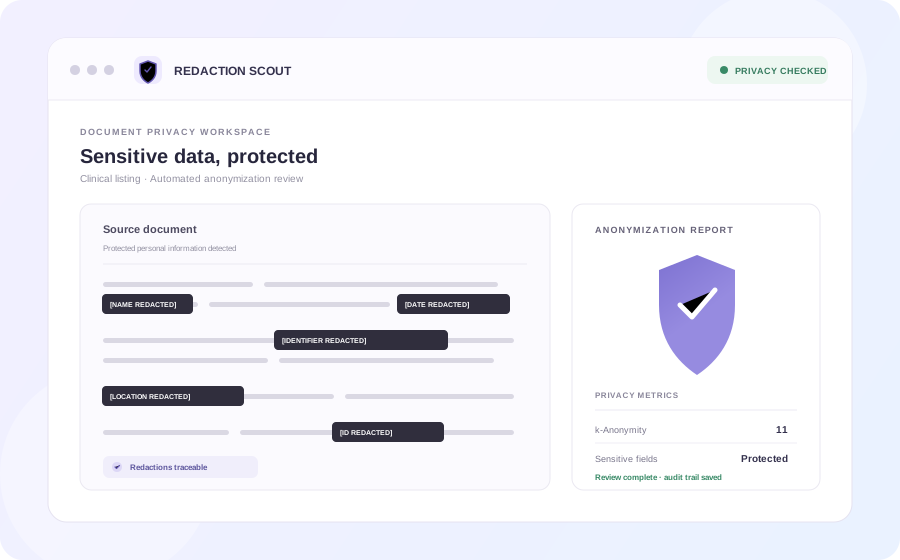
Accurate, automated anonymization and redaction that helps protect sensitive clinical and commercial information across thousands of pages.
AI AGENTS TRUSTED BY LIFE SCIENCES ORGANIZATIONS

Redaction Scout, available within the Narrativa Navigator platform, can scan thousands of pages within minutes and redact specified information with just a few clicks.
Anonymization and redaction are critical steps in protecting the identity of clinical trial participants and safeguarding proprietary business information. Redaction, a subset of anonymization, involves masking personally identifiable information (PII), protected personal data (PPD), and commercial confidential information (CCI) in compliance with global regulatory standards. As clinical datasets grow in complexity and size, manually redacting sensitive content becomes increasingly time-consuming and prone to error.
Redaction Scout automates this process using AI agents and the Narrativa Knowledge Graph, enabling accurate, efficient, and compliant redaction across large-scale clinical documents.
Automatically scans and redacts sensitive information from clinical documents, regardless of length or complexity
Supports PII, PPD, and CCI redaction in accordance with FDA, EMA, Health Canada, and other global guidelines
Fully customizable Anonymization Schema Configuration for flexible, rule-based data masking
Integrates seamlessly with SDTM and ADaM datasets for comprehensive data protection
Employs blacklist and pattern-matching capabilities to detect and redact high-risk terms and identifiers
Ensures compliance with data privacy regulations while supporting transparency in public disclosures
Maintains consistency and accuracy across entire documents
Saves you time by checking thousands of pages of clinical documents with a few clicks
Uses customizable parameters to improve the anonymization and redaction processes
Improves efficiency by proactively approaching data and document anonymization
Boosts your team’s efficiency by sparing them from going through every page manually
Anonymization is the process of removing information that could be used to identify study participants in both direct and indirect manners, like gender, age, and country, among others. Redaction is a subclass of anonymization that involves data masking to protect clinical trial participants. This can be personally identifiable information (PII), personal protected data (PPD), or sensitive and/or proprietary business information, known as commercial confidential information (CCI). It is important to note that regardless of the masking technique, health authorities, such as the Food and Drug Administration (FDA), Health Canada, and the European Medicines Agency (EMA), have their own rules and guidelines when it comes to permitted levels of anonymization and redaction. Depending on the context and the health authority, anonymization could be done while the study is being conducted or after the documents have been submitted to the governing bodies.
Clinical trial participants’ data are often collected in large databases, like the Study Data Tabulation Model (SDTM) and the Analysis Data Model (ADaM), that contain hundreds or thousands of entries pertaining to the study subjects. The information contained in these datasets is used to develop clinical documents, which could be thousands of pages long or even longer in larger trials. Therefore, these datasets should ensure that participants’ information is masked to avoid identifying the person. So, how can Narrativa’s AI agents help with this?
The use of Narrativa’s redaction solution will help you anonymize and redact sensitive information with the press of a few clicks. Our solution will scan through the clinical documents, regardless of their size, to determine the information eligible for masking.
With our anonymization and redaction solution, the information of your study population and your organization’s commercial secrets are kept without compromising the policies of health authorities and transparency laws.
Protection built for every page. Redaction Scout automates sensitive-data discovery and anonymization across clinical documents, combining AI agents and the Narrativa Knowledge Graph with configurable rules and a clear path to expert review.
Automatically scan and redact clinical documents of any length or complexity, finding sensitive details across thousands of pages without manual page-by-page review.
Mask personally identifiable information, protected personal data, and commercial confidential information to safeguard participants and proprietary business details.
Set up a flexible, customizable Anonymization Schema and tailor what gets masked to each document, study, and privacy requirement.
Use custom blacklists and pattern matching to catch identifiers and other sensitive details consistently across documents.
Support FDA, EMA, Health Canada, and other global guidance with configurable protections. Maintain privacy compliance while supporting transparent public disclosures.
Integrate with SDTM and ADaM datasets, then give clinical teams a clear path to verify redactions before sharing. Maintain consistent protection of participant privacy and confidential information.
Redaction Scout, available within the Narrativa Navigator platform, scans thousands of pages in minutes and redacts specified information with just a few clicks.
AI agents and the Narrativa Knowledge Graph help teams protect clinical trial participants and confidential business information while keeping large-scale document workflows accurate and reviewable.
Learn how automated anonymization supports secure, transparent clinical-document workflows.
Anonymization removes information that could identify study participants, directly or indirectly—for example, names, age, gender, or country. Redaction is a form of anonymization that masks selected information such as personally identifiable information (PII), protected personal data (PPD), or commercial confidential information (CCI).
Teams can configure the solution to identify and mask PII, PPD, CCI, and other high-risk terms using custom schemas, blacklists, and pattern-matching rules. This supports consistent handling of participant information and proprietary business details.
Clinical studies can produce SDTM and ADaM datasets with hundreds or thousands of subject-level entries, alongside documents that run to thousands of pages. Redaction Scout scans documents at scale, helping teams find sensitive details without manually checking every page.
Health authorities including the FDA, EMA, and Health Canada have guidance for permitted levels of anonymization and redaction. Configurable rules help teams apply the right approach to each workflow while supporting transparent public disclosure and expert review.
Anonymization is the process of removing information that could identify study participants directly or indirectly, such as gender, age, and country. Redaction is a subclass of anonymization that masks data to protect clinical trial participants. This may include PII, PPD, or sensitive and proprietary business information known as CCI. Health authorities—including the Food and Drug Administration (FDA), Health Canada, and the European Medicines Agency (EMA)—have their own rules and guidelines for permitted levels of anonymization and redaction. Depending on the context and authority, anonymization may take place during a study or after documents have been submitted to governing bodies.
Clinical trial participants’ data are often collected in large databases, such as the Study Data Tabulation Model (SDTM) and the Analysis Data Model (ADaM), which contain hundreds or thousands of entries about study subjects. This information is used to develop clinical documents that may run to thousands of pages. These datasets should ensure participants’ information is masked to avoid identifying individuals. Narrativa’s AI agents help teams manage this at scale.
Narrativa’s redaction solution helps teams anonymize and redact sensitive information with the press of a few clicks. It scans clinical documents regardless of size to determine which information is eligible for masking.
With this solution, information about study populations and organizational trade secrets can be protected without compromising health authority policies and transparency laws.