

Artificial intelligence (AI) and its related tools, like generative AI, have become integral to performing everyday work for many professionals. As generative AI advances, its ability to produce high quality and coherent content continues to grow. However, even the most advanced models will perform poorly if they are not provided with high quality written prompts.
This is especially important in industries such as life sciences, healthcare, and finance, where AI systems may be used to support clinical documentation, regulatory content creation, and clinical data analysis.
To help counter this, here are some tips for effective prompt writing for generative AI.
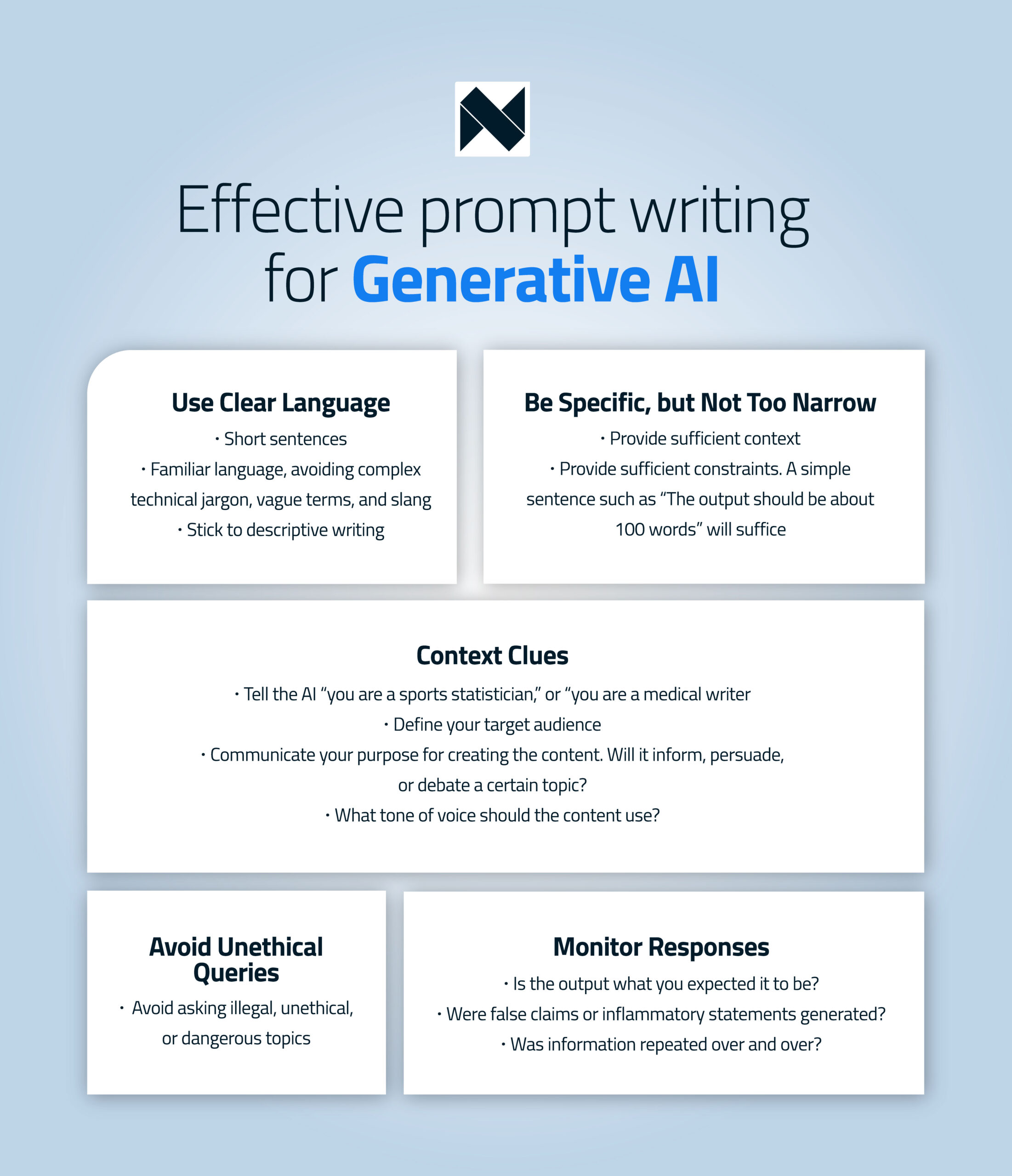
Use clear language
The most effective prompts are simple and help guide the AI model’s understanding of what you want produced.
- Use short sentences.
- Use familiar language and avoid complex technical jargon, vague terms, and slang.
- Stick to descriptive writing and do not assume the model understands cultural nuances.
Clear instructions are particularly important when AI systems are used for specialized tasks such as medical writing, scientific reporting, or regulatory documentation.
Be specific, but not too narrow
Vague prompts leave generative AI struggling to generate meaningful output, while overly narrow prompts hinder flexibility.
❌ Too general:
“Write a social media post for me.”
✅ Better:
“You are a [job title]. Draft an engaging LinkedIn post about [topic]. The target audience is [audience]. Include three high performing hashtags. Example: [example].”
- Provide sufficient context.
- Include constraints like approximate length, for example about 100 words.
- Avoid overloading the prompt with too many constraints because that can restrict creativity.
Context clues
Adding context helps the AI generate more accurate and relevant responses. Consider including:
- Persona: “You are a sports statistician” or “You are a medical writer.”
- Audience: General readers versus specialists like doctors or engineers.
- Purpose: Is the goal to inform, persuade, or debate?
- Tone of voice: Exciting, friendly, or professional.
- Example content: Include a sample and say “Make it similar to this.”
Providing clear context is especially valuable when AI is used in life sciences workflows, where prompts may guide systems to generate summaries of clinical data, scientific reports, or regulatory documentation.
Avoid unethical queries
This may seem obvious, but it is important to reinforce that generative AI cannot always evaluate the ethics of its output.
- Do not ask for illegal, unethical, or dangerous content.
Responsible prompt writing is particularly important in regulated sectors such as healthcare and life sciences, where accuracy and compliance are essential.
Monitor responses
Even with well crafted prompts, generative AI may go off track. It is important to monitor and refine outputs.
Ask yourself the following questions:
- Is the output as expected? If not, refine your prompt with more clarity or context.
- Were there false claims or harmful statements? Adjust the prompt to guide tone and accuracy.
- Was the content repetitive? Ask for it to be more concise or break it into sections.
Careful review is especially important when AI is used to assist with clinical documentation, medical writing automation, or scientific communication.
Where does Narrativa come in?
Narrativa is a leading generative AI company with a powerful platform packed with features that help you analyze data, write in different tones, generate reports, and more. We serve industries including life sciences, finance, marketing, and entertainment.
Our platform can help organizations transform complex datasets into clear narratives, supporting tasks such as clinical data analysis, regulatory documentation, and automated report generation.
Our clients include Blood Cancer United, The Wall Street Journal, Microsoft, and other industry leaders.
In addition to the tools on our website, many clients also come to us to automate repetitive tasks. This allows their teams to focus on high value work instead of manual data processing or repetitive content creation.
About Narrativa
Narrativa Agentic AI solutions unlock a faster, smarter future for life sciences organizations, helping them to efficiently produce complex, high-volume documentation for regulatory and commercialization workflows. By automating content creation, Narrativa delivers greater speed, accuracy, and consistency—while ensuring full compliance in highly regulated environments.
Narrativa Navigator Platform provides secure and specialized Agentic AI-powered automation features. It includes complementary user-friendly tools such as the Medical Authoring Companion for CSR and Protocol generation, BioStat Developer for AI Agents for TLF generation and SDTM and ADaM dataset generation, Narrative Pathway, and Redaction Scout, which operate cohesively to transform clinical data into submission-ready documents for regulatory and commercialization. From database to delivery, pharmaceutical sponsors, biotech firms, and contract research organizations (CROs) rely on Narrativa to streamline workflows, decrease costs, and reduce time-to-market across the clinical lifecycle and, more broadly, throughout their entire businesses.
Explore www.narrativa.com and follow on LinkedIn, Facebook, Instagram, and X.