

What the FDA and EMA joint AI principles mean for regulatory submissions
What the FDA and EMA joint AI principles mean for regulatory submissions

Regulatory Submissions
Regulatory Submissions
Regulatory Submissions
By Sofía Sánchez González
Last week, the Food and Drug Administration (FDA) and the European Medicines Agency (EMA) shared a statement outlining 10 guiding principles for using AI to generate evidence across the drug product life cycle. This is a clear signal: regulators want to support AI in drug development, but they also want teams to use it in a way they can trust.
For pharma and biotech, this matters now because AI is moving into regulated work. And once AI touches regulated evidence, it also impacts regulatory submissions. That means teams need clear methods, strong data, and documentation that holds up under review.
Why this matters for regulatory submissions
Regulatory submissions rely on trust. Agencies need to understand how you generated your evidence. In short,
they need to see that your process is controlled.
AI can absolutely help. It can speed up research, improve decision-making, and strengthen safety monitoring. It can also reduce time to market and support better predictions of toxicity and efficacy.
At the same time, AI adds new risks. Models can change over time. Data can be incomplete or biased. And results can be hard to explain if the system is not designed for transparency. So,
if you cannot prove reliability, regulators may not accept the evidence.
AI is shifting from experiments to submission-ready systems
Many teams already use AI in R&D. That is not new. What is changing is the role AI can play in regulatory decision-making.
Because of that, the bar is higher. You need more than a strong model. You need a repeatable process.
You need controls, clear ownership, and audit trails. In practice, AI evidence quickly becomes a cross-functional effort, involving:
- Regulatory affairs
- Clinical development
- Quality and compliance
- Pharmacovigilance
- Data and IT
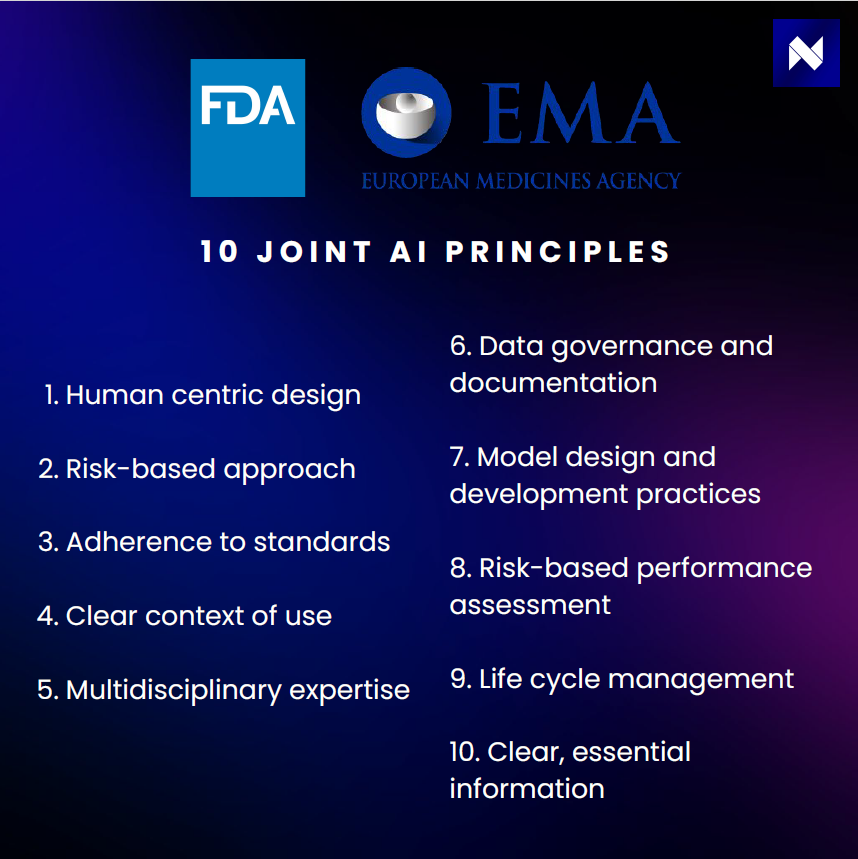
This EMA-FDA initiative builds on collaborative work following the FDA-EU Bilateral meeting in April 2024.
Three principles matter most for submissions
The full set of principles covers many topics, but for regulatory submissions, three themes stand out.
- Clear context of use
- Define what the AI system is meant to do.
- Explain which decision it supports and where it fits in the workflow.
- Specify what data it relies on and what its limits are.
- If the context is unclear, the evidence becomes harder to justify and defend.
- Data governance
- Control and document where the data comes from.
- Track how data is processed, cleaned, and transformed.
- Confirm data quality, reduce bias, and keep version history.
- Be able to show the full chain from input to output during review.
- Adherence to standards
- Align AI development and validation with recognized regulatory and quality expectations.
- Use consistent documentation and review processes across teams.
- Apply clear controls for model updates, performance monitoring, and change management.
- Standardized practices make AI evidence easier to assess and more credible.
This is where platforms like Narrativa® Navigator can add value. It helps teams define AI use cases with the right structure and supports strong governance so AI-generated evidence is easier to document, review, and scale.
What pharma teams should do next
You do not need to wait for more guidance to act. You can start with a few practical steps:
- List your AI use cases. Focus on anything that could influence clinical conclusions or a submission.
- Write the context of use early. Keep it specific and document assumptions and limits.
- Strengthen data governance. Improve traceability, quality checks, and documentation.
- Validate for real-world conditions. Test performance across datasets and populations.
- Align teams early. Bring regulatory, clinical, quality, and data teams into the same process.
Final takeaway
AI integration is good news, but it comes with expectations. The FDA and EMA are supporting AI in drug development while setting clear direction for how AI-generated evidence should work in regulated environments. If you
build around a clear context of use and strong data governance, you will be in a much better position to use AI in regulatory submissions with confidence.
About Narrativa
Narrativa® is the global leader in generative AI content automation. Through the no-code Narrativa® Navigator platform and the collaborative writing assistant, Narrativa® Sidekick, organizations large and small are empowered to accelerate content creation at scale with greater speed, accuracy, and efficiency.
For companies in the life sciences industry, Narrativa® Navigator provides secure and specialized AI-powered automation features. It includes complementary user-friendly tools such as Clinical Atlas, Narrative Pathway, R-Developer for TLFs, and Redaction Scout, which operate cohesively to transform clinical data into submission-ready regulatory documents. From database to delivery, pharmaceutical sponsors, biotech firms, and contract research organizations (CROs) rely on Narrativa® to streamline workflows, decrease costs, and reduce time-to-market across the clinical lifecycle and, more broadly, throughout their entire businesses.
The dynamic Narrativa® Navigator platform also supports non-clinical industries such as finance, marketing, and media. It helps teams drive measurable impact by creating high-quality, scalable content on any topic. Available as a self-serve SaaS solution or a fully managed service, built-in AI agents enable the production, refinement, and iteration of large volumes of SEO-optimized news articles, engaging blog posts, insightful thought leadership pieces, in-depth financial reports, dynamic social media posts, compelling white papers, and much more.
Explore www.narrativa.com and follow on LinkedIn, Facebook, Instagram, and X. Accelerate the potential with Narrativa®.