

The shift from clever prompts to real systems
Most teams still view AI as a clever prompt in a chat box: you ask, it answers, magic happens. Yet in pharmaceutical settings, where accuracy, consistency, and compliance are non-negotiable, that magic often breaks under pressure, especially when tasks are complex, context is messy, or stakes are high. At Narrativa, we’ve seen this firsthand through our work with top global pharmaceutical companies, who require not just answers but intelligent systems that can adapt, improve, and scale.
The truth is simple: prompts are ingredients, not the meal. If you want reliability, particularly for generating patient narratives, redaction reports, or regulatory submissions, you need a recipe. In practice, this means turning isolated prompts into structured systems that plan, decide, act, and improve continuously.
This article offers a field guide to that transformation. We’ll explore four foundational principles: prompt chaining, routing, parallelization, and reflection, and weave them together through the lens of context engineering. Think of this as a blueprint for building agentic AI systems that can be trusted in real-world, high stakes production, especially in pharma.
Start with flow, not flair
Every successful AI system begins with a structured flow. The simplest form is a sequence of tasks, where a big objective is broken down into smaller goals with defined inputs and outputs. This is the essence of prompt chaining, which we leverage at Narrativa when building automated workflows for Clinical Study Reports (CSRs) or patient safety narratives.
Instead of asking an assistant to write an entire CSR from scratch, we break the process down: extract data from SDTM files, summarize adverse events, validate consistency, and format the output according to EMA or FDA templates. By chaining steps together, we reduce cognitive load, preserve clarity, and gain points of intervention. If step two fails, we know exactly where to look and how to improve it.
Moreover, the quality of a chain depends heavily on clean handoffs. When working with pharma clients, we design structured outputs using JSON schemas or tabled fields that pass seamlessly between steps. Vague, free-form text introduces risk; structured outputs ensure traceability and compliance.
When straight lines are not enough
Sequential flows are foundational, but real-world pharma workflows rarely follow a straight line. Clinical narratives may differ by study design, indication, or patient population. That’s where routing comes in.
Routing transforms agents from simple responders into decision-makers. At Narrativa, our systems evaluate input to decide the right path, whether to apply a redaction model for PII or to trigger a data clarification workflow if inconsistencies are detected. For example, if a medical writer submits a patient narrative with missing lab results, our system can detect the gap, query the relevant database, or flag it for review.
This is particularly useful inside prompt chains. Mid-chain, we might assess whether to escalate a borderline adverse event to a human reviewer or proceed with synthesis. These adaptive decisions convert rigid automation into flexible, pharma-grade intelligence.
Speed is a product feature
As agentic systems grow, latency becomes a bottleneck. In pharma, time is a critical factor, whether racing toward regulatory submission deadlines or accelerating time to market for a life-saving therapy. Parallelization is our answer to this.
Instead of running tasks sequentially, for example extracting data from MedWatch forms, CIOMS, and CRFs one at a time, we run them simultaneously. When automating narrative generation or CSR tables, this allows us to compile and analyze large datasets in parallel, drastically reducing time to insight.
This isn’t just a performance boost; it’s a design principle that guides our work with clients like Pfizer, where we’ve shortened report generation from weeks to days, or even hours. Tasks like TLF generation, validation checks, and compliance audits can all happen concurrently, so medical writers and regulatory teams can move faster with confidence.
Quality is not an accident
No matter how sophisticated your flow, quality still requires conscious oversight, especially in pharma, where every word might be scrutinized by regulators. Reflection is how we embed that quality.
Narrativa systems incorporate self-review steps at strategic points. Sometimes it’s a single model switching roles, from generator to fact-checker. Other times, we use dual-agent reflection: one model writes, another critiques. This division reduces bias and improves feedback. For instance, in our Sidekick co-writing tool, this loop helps ensure tone, clarity, and compliance with templates.
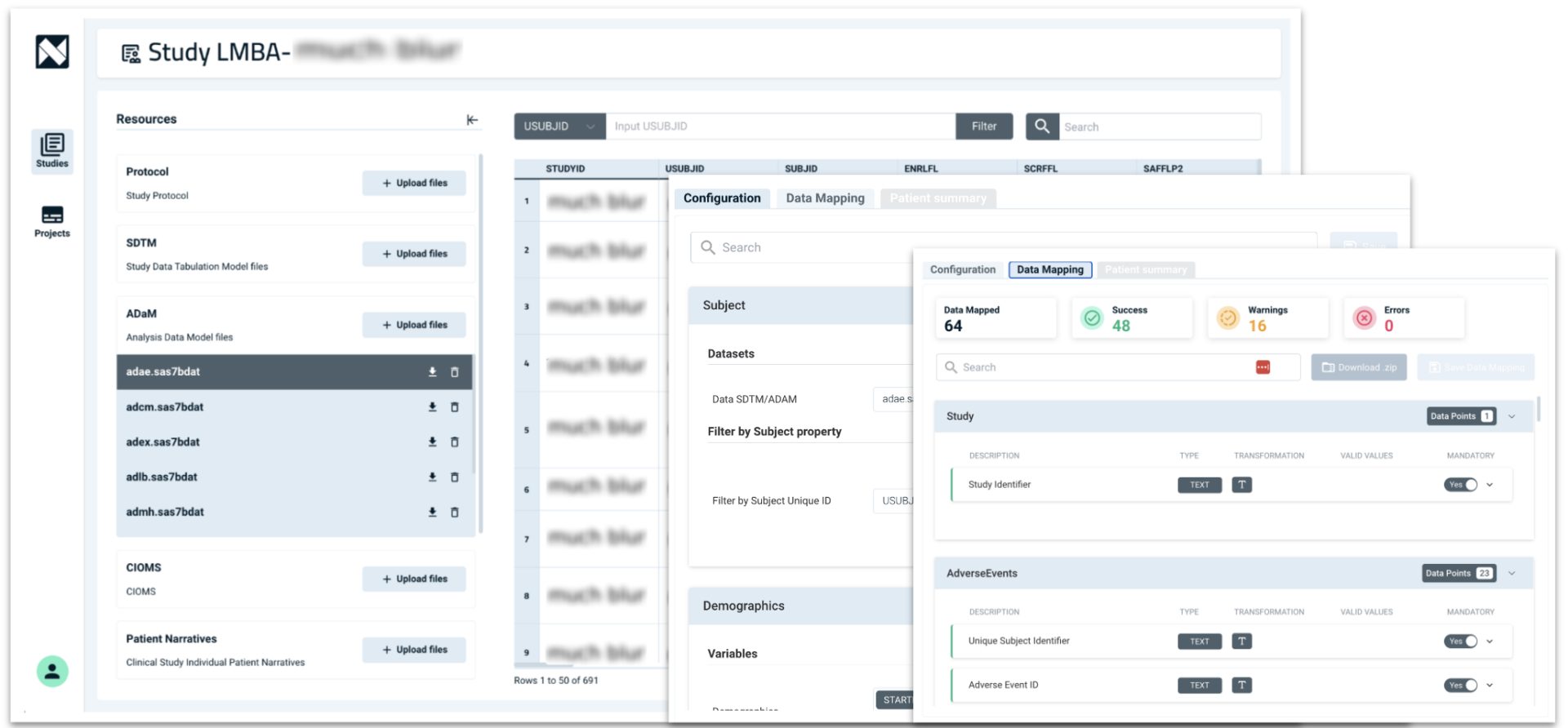
When generating clinical or regulatory documents, our systems validate against checklists: are all adverse events included? Are the timelines accurate? Is the format FDA- and/or EMA-compliant? This isn’t an optional luxury; it’s a configurable control that pharma companies use to match quality levels to risk.
Context is your real model
You can get the flow, the speed, and the quality right, but if your model lacks context, the outputs will fall short. Context engineering is how we bridge that gap.
In our pharma deployments, this means injecting structured knowledge, like trial protocols, safety profiles, company style guides, or previously approved submissions, into every generation step. We design contextual pipelines that retrieve, filter, and deliver the right documents at the right time, often through Narrativa’s Knowledge Graph.
Good context includes not just data but also intent and role. For instance, telling the model: “You are a regulatory writer drafting a Phase III CSR for a cardiovascular drug using the sponsor’s template.” This situational awareness often lets a mid-tier model outperform a more powerful one that’s flying blind.
The playbook in motion
To see this in action, imagine building an AI copilot for regulatory intelligence.
- Orchestrate a flow to clarify the objective, gather sources (from internal databases or public repositories), extract relevant safety data, synthesize findings, and generate a briefing ready for leadership.
- Use routing to select the appropriate regulatory template (e.g., EMA vs. FDA), or to trigger clarification if the brief lacks specificity.
- Run search and extraction in parallel across safety data, trial metadata, and literature.
- Reflect before delivery. Review for coverage, accuracy, and compliance alignment.
- Embed context. Define the agent’s role, load previous reports as examples, and integrate source documents in real time.
Patterns that compound
These techniques don’t exist in silos, they amplify each other. Prompt chaining gives you structured checkpoints. Routing adapts behavior. Parallelization improves responsiveness, while reflection adds quality. Context multiplies the value of each step.
Together, these patterns create resilient, scalable agentic systems that pharmaceutical teams rely on every day. At Narrativa, we’ve seen clients reduce documentation time by over 70%, improve consistency across reports, and increase submission readiness without expanding headcount.
Practical guidance for builders
- Design processes between steps using schemas and validation rules.
- Make decisions explicit, start with routing rules you can explain.
- Measure latency and quality independently.
- Budget for reflection aligned with regulatory risk.
- Version your context like software.
- Plan for human handoffs when ambiguity or risk is high.
- Prioritize privacy and compliance by minimizing data exposure and logging tool use.
Common failure modes and how to avoid them
- Overloaded prompts. Break complex tasks into chains.
- Free-text handoffs. Use structured formats.
- Overfitting routes. Handle 80% with rules, and clarify the rest.
- Blind parallelization. Only run truly independent tasks concurrently.
- Vague reviews. Give reflection agents checklists.
- Context overload. Narrow retrieval to what matters.
What good looks like
In production, these choices show up as better user experiences and stronger outcomes. Users get faster, more relevant answers. Teams debug by step, add features incrementally, and scale quality without scaling cost. Regulatory teams trust the system because it’s transparent and reliable.
The mindset that unlocks durable value
Winning teams treat AI not as a static artifact, but as a living, evolving system. They prioritize control flows over clever prompts. They bake quality into the process, not just the output. They contextualize thoroughly and reflect intentionally. At Narrativa, this mindset is what powers our work across pharma: co-writing tools, report generators, redaction engines, and more.
Building agentic AI that actually works in the real world
If the first generation of AI amazed us with fluent text and impressive demos, the next one will be defined by something far more practical: actually getting things done. For pharmaceutical and biotech companies, this is not theoretical, it’s a core operational requirement. Real-world AI in pharma must go beyond clever conversation. It must reason across regulatory steps, learn from study data, connect to live clinical systems, and track its progress in producing accurate, auditable content.
That’s what agentic AI is all about. And through our work with global pharma leaders, Narrativa has proven that agentic systems can bring real transformation to areas like Clinical Study Report (CSR) generation, patient narratives, redaction, and safety monitoring. But to make it truly work, we need to give AI four superpowers: the ability to remember, to learn, to connect, and to pursue clear goals. Without these, even the most advanced model is just a smarter chatbot.
Let’s explore how these four capabilities combine to create AI that performs reliably, adapts intelligently, and delivers tangible results in pharmaceutical environments.
Remembering what matters
If you’ve ever been on a customer service chat that forgot what you said two messages ago, you already know why memory is critical. In regulated domains like pharma, this becomes even more essential. An AI agent generating multiple narratives across studies must maintain context, not just within a session, but across projects.
Large language models come with short-term “working memory,” the context window. It holds recent conversation history and instructions. But once it’s full, older information disappears. In pharma, where long-running tasks and cross-document consistency are crucial, this isn’t enough.
To support real-world clinical workflows, agentic AI needs two layers of memory:
- Short-term memory acts like a working scratchpad, holding outputs from clinical data extraction tools, recent validation feedback, and event classification outcomes.
- Long-term memory stores persistent knowledge such as therapeutic area guidelines, sponsor-specific templates, and prior narrative decisions.
Narrativa® Navigator leverages both layers. For example, our Narrative Pathway solution can maintain memory across thousands of patient narratives, ensuring consistency in terminology and event classification. The power lies not in storing everything, but in retrieving exactly what matters when needed.
Watch how Narrativa® Narrative Pathway works
Learning and adapting over time
Once an agent remembers, the next step is helping it improve. Regulations evolve, sponsor preferences shift, and writing styles vary by geography or reviewer.
Therefore, agentic AI must continuously adapt. At Narrativa, our solutions employ learning mechanisms such as:
- Preference learning to align output tone and structure with sponsor requirements.
- Policy refinement to optimize decision trees across multi-step clinical workflows.
- Knowledge expansion as new regulatory standards emerge (for example, the E3 standard, which is intended to harmonize the format and content of the clinical study report, or ICH E6, which relates to Good Clinical Practice).
- Procedural updates that adapt how narratives are generated based on reviewer feedback or audit findings.
This approach turns every clinical writing interaction into training data. For example, Sidekick, our co-writing tool, tracks editorial changes and evolves its suggestions. Similarly, our CSR automation module refines its template selection and source referencing logic based on success metrics.
Connecting to the world with the Model Context Protocol (MCP)
An agent that can remember and learn still needs one final ingredient: action. To be operational in the pharma world, AI must connect with trial databases, regulatory repositories, and internal knowledge systems. That’s where the Model Context Protocol (MCP) comes in.
MCP is an open standard that enables interoperability between large language models and external systems. It gives AI the ability to retrieve, process, and act on live data through structured access to:
- Resources, such as CDISC datasets, MedDRA dictionaries, or protocol documents.
- Tools, like medical dictionary lookups, adverse event classification engines, or submission checkers.
- Prompts, which define how the agent should use these tools in regulated environments.
Narrativa’s pharma deployments use MCP-like architecture to orchestrate tools like Redaction Scout or TLF Voyager within a unified agent workflow. This allows AI to synthesize multiple clinical data sources and regulatory requirements into compliant, validated output.
With MCP, the agent doesn’t just suggest text, it acts on real inputs, validates with tools, and prepares documentation for submission. It bridges the gap between language and action.
Giving AI a sense of direction
Even the smartest agent, fully connected and adaptive, is ineffective without direction. Pharma teams require clarity and traceability at every step, which is why agentic AI must operate with clear, measurable goals.
Just like a regulatory writer is tasked with producing a submission-ready CSR or resolving a safety case, the AI needs to understand:
- The current state (e.g., data gaps, unaddressed adverse events).
- The desired goal (e.g., a complete, compliant document).
- How to track progress (e.g., through checklists, accuracy metrics, or validation passes).
Narrativa agents apply this through structured planning and monitoring. For instance, during CSR generation, the system defines stages—data extraction, narrative generation, quality validation—and tracks progress using metrics such as completion rate, consistency checks, and compliance thresholds.
This makes the system not just reactive, but proactive, capable of adjusting strategies, escalating issues, or requesting clarification when needed.
Bringing it all together
When memory, learning, connection, and goals align, AI transforms from a passive assistant into an active contributor. That means:
- Narratives evolve with clinical insight.
- Reports self-correct based on past reviewer feedback.
- Agents pull live data from CDMS or EDC systems, process it, and output usable content.
- Tools know the target, like regulatory readiness or safety case resolution, and work purposefully toward it.
Our clients already use these capabilities to reduce documentation timelines, increase output consistency, and scale quality across regions and teams. Narrativa’s agentic AI solutions build systems that think, learn, connect, and achieve. That’s what real-world AI looks like in pharma, and it’s only the beginning.