

GPT-OSS, an open-source alternative to GPT-5
GPT-OSS, an open-source alternative to GPT-5

GPT-OSS
GPT-OSS
GPT-OSS
By Sofía Sánchez González
The GPT-5 model, which came out in August 2025 and impressed the entire world with its new capabilities, has an open-source version: GPT-OSS. Since the launch of ChatGPT a few years ago, many initiatives such as GPT-J have emerged with the goal of democratizing artificial intelligence. Originally created by EleutherAI, a group of researchers committed to open and accessible AI, GPT-J was part of that early wave. Today, that same spirit continues as GPT-OSS, OpenAI’s open-source model family released in 2025, enters the scene.
In this post we explain why a model accessible to all is important and what it’s capable of doing.
Why launch an open-source model?
For those of you who aren’t aware of GPT-5—surely a very exclusive club by now—know that it’s a language model developed by OpenAI that learns from existing text and can provide different ways of finishing a sentence (similar to predictive text). It can follow long instructions, reason through complex ideas, work with different types of information, and hold more accurate and natural conversations than earlier models. Once trained, it can save you a lot of time, providing linguistic richness and variability along with perfect grammar. In addition, it’s capable of answering a wide variety of questions.
But nobody’s perfect. It isn’t very accessible. You can interact with it through ChatGPT, but only by creating an account and without being able to see the training parameters. OpenAI granted limited access to a privileged few back then when it was released in November 2022 (including Narrativa for a few months). So, who gets full access to the model and all the data needed to train it? Unfortunately, only a handful of the world’s biggest companies.
Eleuther AI wanted to change this and allow everyone to have access to this technology, both companies and individuals, with GPT-J. It’s a necessary step to ensure that artificial intelligence reaches its full potential. Otherwise, it’ll be yet another of society’s inequalities.
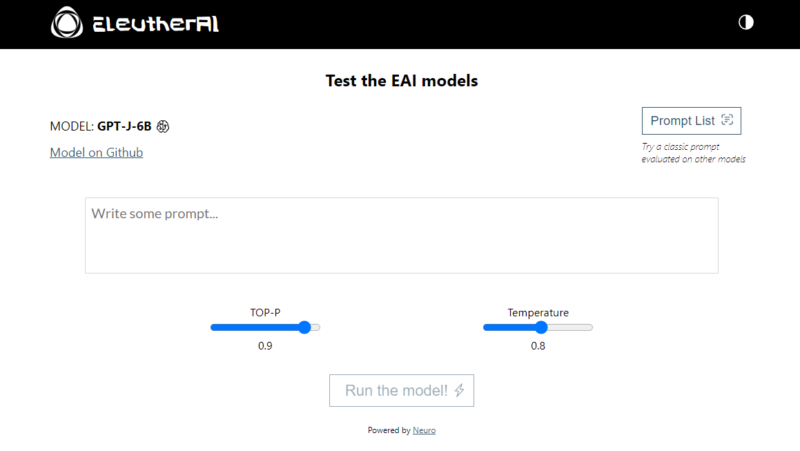
On their official page you can see other models that they have democratized.
And now it seems that OpenAI has embraced this idea with the launch of GPT-OSS.
What can we do with the GPT-OSS model?
GPT-OSS makes it easy to build AI tools without depending on closed systems. Since the weights are open, you can run it locally, customize it, and keep full control over your data and costs. It can generate text, answer questions, summarize information, and support many types of reasoning tasks.
Here are some common uses:
- Create chatbots or virtual assistants
- Summarize long documents or articles
- Generate or rewrite content
- Answer questions based on your data
- Build domain-specific models through fine-tuning
- Deploy AI systems on-premise for privacy and security
- Experiment and research freely with transparent, open-source weights
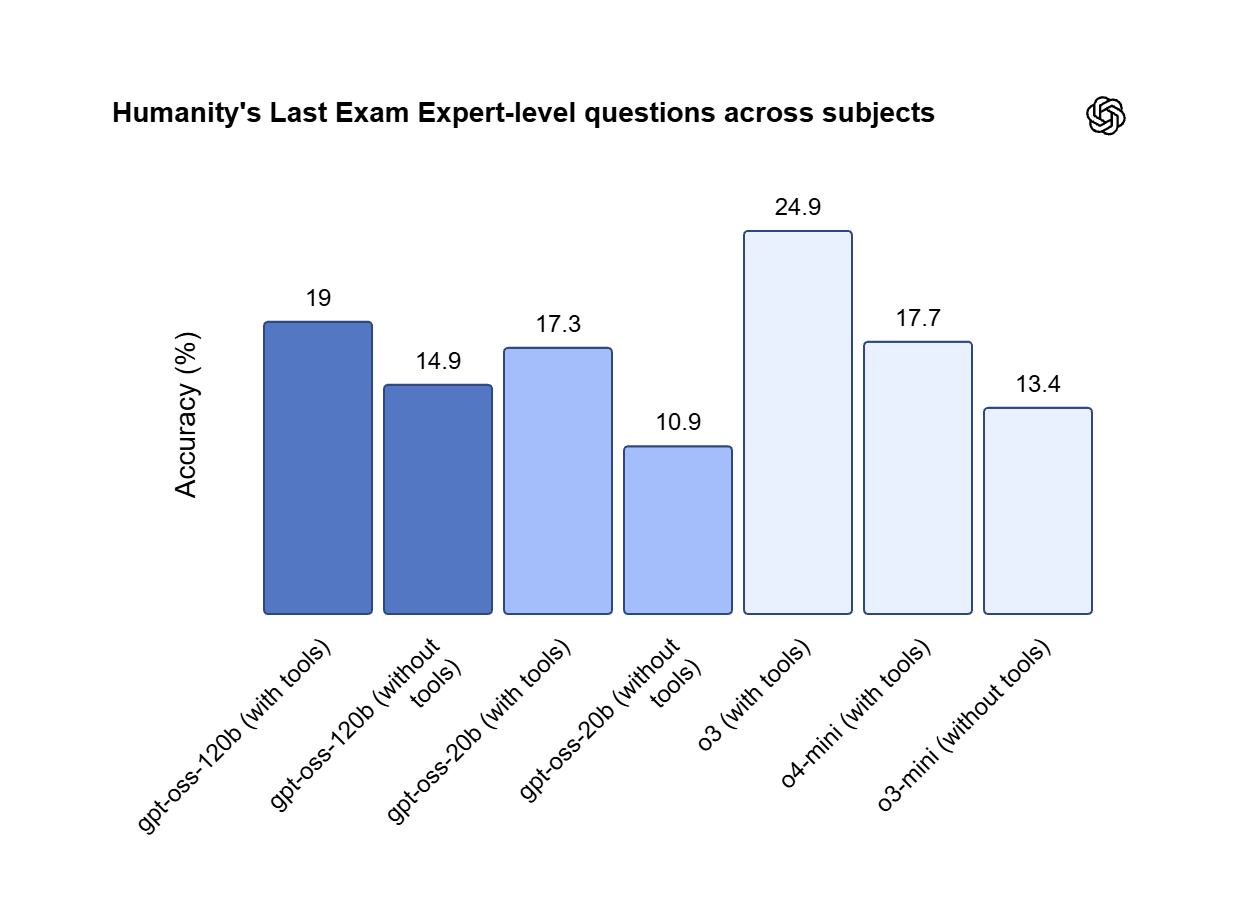
What versions of GPT-OSS are available?
- GPT-OSS-120b: A large MoE model built for high-performance tasks and strong reasoning.
- GPT-OSS-20b: A smaller MoE model that is easier to run locally and good for most everyday applications.
What other models are open source?
There are several open alternatives that aim to provide powerful and accessible models for developers and teams who want transparency and full control. Each one has its own focus and level of complexity.
- Llama 3: A very popular model known for strong performance and broad compatibility.
- Qwen3: An advanced model from Alibaba known for high performance and strong multilingual support.
- Mixtral: A Mixture-of-Experts model that offers a balance of efficiency and text quality.
- Mistral: A fast, lightweight dense model that runs well on local hardware.
- Gemma: A lightweight Google model designed for use on personal devices.
- Phi 3: A small, efficient model ideal for basic reasoning tasks on low-resource machines.
- DeepSeek: A high-performance open model known for strong reasoning and competitive results compared to larger closed models.
The future of these models
It’s very difficult to surpass the achievements of GPT-5 simply because there isn’t any more written text in English to provide further training. This means it can’t continue to grow. So how can the model evolve? GPT-5 would have to be able to understand the world, not just one language. When a child is told what a car is, the next time they see one they understand what it is (even if it is a different type of car). For the GPT-5 model to understand what a car is, it would have to see thousands of images of different cars. For now, that’s a skill only humans possess. The question is: for how long?
Advances in artificial intelligence and in the field of generative AI are increasing. Much is published on the subject and if we read any digital newspaper, it’s very easy to come across news related to AI, but to what extent is all this progress available to society? It’s necessary that both users and recipients are included in the cycle of research, design, development, application, and resolution. If more groups like Eleuther AI or, in this case, OpenAI, continue to make the latest models available to society, then we will easily achieve this goal!
Life Sciences
Can it be used for regulatory submissions like clinical study reports (CSRs)?
No, it cannot be used for regulatory submissions. The current structure and functions of GPT-OSS do not support processing and understanding a complex set of inputs from millions of data points and patients. Therefore, this model cannot be utilized to automate processes such as creating Tables, Lists, and Figures (TLFs) and/or patient safety narratives, which are essential for CSR creation and finalization.
However, if you need to automate regulatory submissions, Narrativa has the answer.
We have developed Narrativa® Navigator to help pharma and biotech companies expedite the process of introducing their life-saving treatments to the market by automating tiresome, repetitive regulatory tasks. Explore our automation solutions for patient safety narratives and TLFs. We help you reduce financial burdens and save time by supplementing the creation of regulatory-compliant documents.
About Narrativa
Narrativa® is the global leader in generative AI content automation. Through the no-code Narrativa® Navigator platform and the collaborative writing assistant, Narrativa® Sidekick, organizations large and small are empowered to accelerate content creation at scale with greater speed, accuracy, and efficiency.
For companies in the life sciences industry, Narrativa® Navigator provides secure and specialized AI-powered automation features. It includes complementary user-friendly tools such as Clinical Atlas, Narrative Pathway, R-Developer for TLFs, and Redaction Scout, which operate cohesively to transform clinical data into submission-ready regulatory documents. From database to delivery, pharmaceutical sponsors, biotech firms, and contract research organizations (CROs) rely on Narrativa® to streamline workflows, decrease costs, and reduce time-to-market across the clinical lifecycle and, more broadly, throughout their entire businesses.
The dynamic Narrativa® Navigator platform also supports non-clinical industries such as finance, marketing, and media. It helps teams drive measurable impact by creating high-quality, scalable content on any topic. Available as a self-serve SaaS solution or a fully managed service, built-in AI agents enable the production, refinement, and iteration of large volumes of SEO-optimized news articles, engaging blog posts, insightful thought leadership pieces, in-depth financial reports, dynamic social media posts, compelling white papers, and much more.
Explore www.narrativa.com and follow on LinkedIn, Facebook, Instagram, and X. Accelerate the potential with Narrativa®.