Navigating the COVID-19 pandemic: Artificial intelligence, natural language generation, and the COVID-19 Tracking Project

COVID-19
COVID-19
COVID-19
By Sofía Sánchez González
The past two years have confronted humanity with a variety of unprecedented challenges due to the far-reaching COVID-19 pandemic. In response to this tragedy have come monumental new advances in science and technology – namely the vaccines developed to prevent COVID-19 and curb the spread of the virus, as well as the detection methods used to identify it. However, an area that the public might not naturally associate with scientific and technological progress related to COVID-19 is artificial intelligence. Artificial intelligence (AI) is a subject matter with which most are already tangentially familiar. It is used every day when interacting with our mobile devices, or when deciding what film or TV programme to stream. Even marketing messaging is now produced using AI! But what one may not know is that a subfield of AI, called natural language generation (NLG), has played a pivotal role in our response to the COVID-19 pandemic. NLG has been essential in assessing massive amounts of COVID-19-related data to, among other things, provide accurate and easy-to-understand information to multiple stakeholders around the world.
Simply put, NLG is a computer software process that collects and transforms raw data into written natural human language. Though this technology is widely used by many businesses and organisations in a variety of sectors, it has proven particularly useful in the life sciences industry during these unprecedented times. To this point, the automation of clinical study reports, patient safety narratives, TLFs, and electronic common technical documents, better known as eCTDs, have enabled medical writers to perform faster and improve efficiencies. Pharmaceutical companies have also substantially reduced costs and accelerated regulatory submissions, bringing much needed new medical developments to the market quicker. With these and other useful applications in mind, the COVID-19 Tracking Project was created to further contribute to the COVID-19 response.
About the project
The COVID-19 Tracking Project is an international initiative that aims to facilitate the transformation of data about the virus into essential knowledge using NLG. It is a collaborative effort between Los Angeles-based Narrativa, one of the global pioneers in the NLG space, and several international partners including: the Spanish international news agency Agencia EFE; the Spanish public corporation for public radio and television services Corporación de Radio y Televisión Española (RTVE); the online news outlet Infobae; the information provider Applied XLabs; the location intelligence platform Carto; and the design experience and visual storytelling company DesignIt.

Some of our partners
“Throughout the pandemic, it seemed as if everyone was drowning in data and did not fully understand what the data surrounding COVID-19 was actually saying. We sought to empower institutions, the media, and the public through natural language generation by giving them the critical knowledge they needed. It’s our mission to better the world with technology and we saw an opportunity to help,” says Narrativa President Jennifer Bittinger.
More about the tool
Data are first independently collected and verified for accuracy by various health authorities themselves, including Germany’s Robert Koch Institute1, the Dipartimento della Protezione Civile in Italy2, and Johns Hopkins University in the United States3. The tool then aggregates the verified data from these sources and structures it into a legible and interpretable format. Daily tests are performed to validate that the data extraction process is correct and in working order. For instance, if any data source changes its format in a way that negatively impacts the tool’s software, the tests fail, and the appropriate parties are notified so they can manually intervene and resolve the issue quickly. The software records every update in a database accessible via an application programming interface, commonly known as an API. Finally, and most importantly, AI and NLG convert the data into clear and intelligible text and a chart (Figure 1). The entire process happens automatically and 24/7. Other types of graphic content that can be generated include images and banners which, like the text and chart outputs, can be quickly disseminated and understood by multiple audiences, including the media and public.
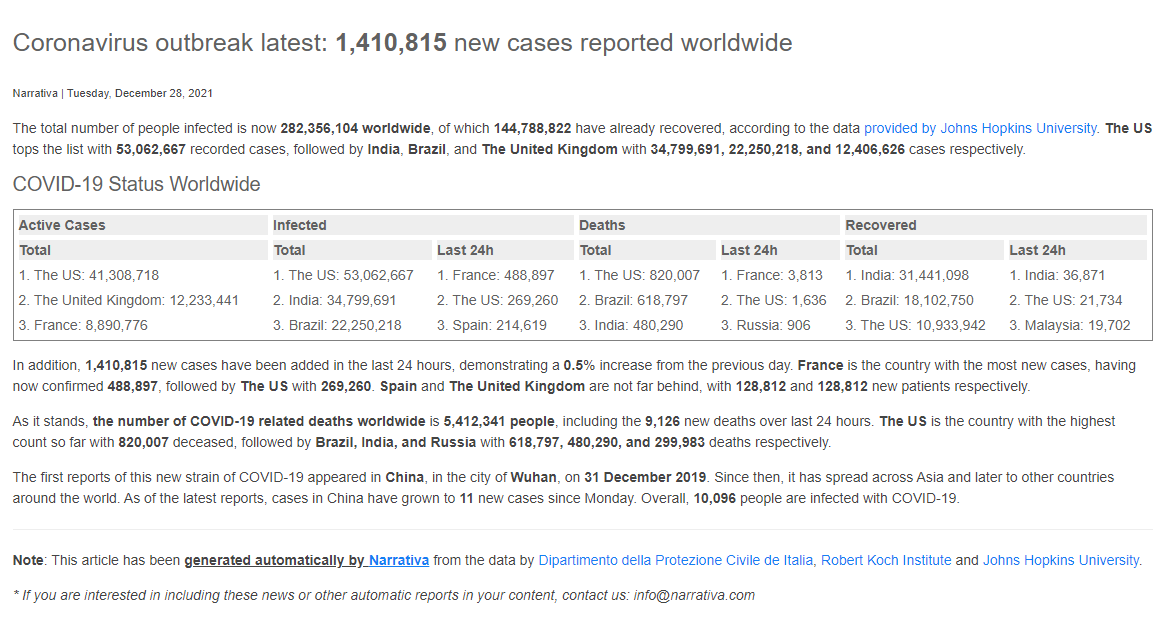
Figure 1
Such easy access to accurate information about COVID-19 has been especially useful given the volume of inaccurate and false information that has been circulating among online communities. Moreover, the tool allows one to check the current COVID-19 statistics for any country on Earth, or, more granularly, for various regions, states, autonomous communities, and provinces. Aside from offering a general summary of the data, the information is represented visually through an interactive map and shows the worst hit countries alongside the number of daily positive cases being documented. Another helpful feature of the project is the information alert system, which notifies users of the latest news on COVID-19. For example, if there is a notable increase or decrease in the number of cases within a region of interest, an alert is automatically generated. This feature is particularly helpful because accurate information and fixed content again reaches the public directly, eliminating the inevitable alteration of information as it passes from person to person and is taken as fact.
Narrativa continues to offer reporting that is updated at least every hour, as the insights provided by the COVID-19 Tracking Project have been vital in helping people make more informed decisions about COVID-19. “The efforts of the COVID-19 Tracking Project have left humanity better prepared when a global pandemic happens again,” echoes Bittinger. To reach a vast amount of people, the simple yet comprehensive tool is currently directly available to the public in English, Spanish, and Italian. This endeavour is not-for-profit, so any person or institution can freely use the information provided by the COVID-19 Tracking Project, which has become a large and expansive repository of data, reports, graphs, and images associated with the evolution of the virus. To interact with the tool from the COVID-19 Tracking Project, please visit covid19tracking.narrativa.com.
The Hook and Narrativa collaborate in the generation of audiovisual COVID-19 content
Narrativa and The Hook are continuing to collaborate throughout the COVID-19 crisis with data-generated audiovisual content.
The Hook was one of the first companies to generate automatic content from data, at scale and in real time. They have invested in audiovisual content, which is the most consumed type of content on social networks and the most successful on the Internet.
The Hook and Narrativa have been collaborating on projects since they started out, as in the case of sports competitions. For this reason, in the coronavirus crisis they have decided to join forces to combine data and narratives and make audiovisual pieces that inform the population about the situation.
Narrativa, through its COVID-19 monitoring project, provides The Hook with data on the daily evolution of the virus. Using this information, The Hook produces videos that are updated every 60 minutes and are available to the user via Vimeo, Dailymotion or Twitter.
In this way, the automation of content and the use of data combine to provide information to the user quickly, easily and reliably.
Narrative joins Data for Hope’s challenge to tackle COVID-19 with the use of data
Narrativa, the pioneering Spanish Artificial Intelligence startup, is collaborating on the Data for Hope project which is committed to providing solutions to the COVID 19 crisis through data collection and looking beyond the disease, its containment and the tragedy.
On April 15, a hackathon event was held in order to find a way out of the current health crisis through the data that is being generated. Data entrepreneurs, doctors, researchers and public institutions met online to find a solution based on data collection as a possible way out of the current scenario.
Three main challenges to overcome in the future were presented; models for predicting the evolution of the pandemic, prevention in Africa and Latin America and models based on mobility in a future of de-escalation. The solutions proposed by the experts were presented to the Government with the aim of helping to define the new reality.
Narrativa collaborated on this initiative by making its COVID-19 database available to participants. This not-for-profit project was developed by the startup at the start of the health emergency and provides the media and other institutions with the largest database of data, reports, graphs and images of the evolution of the virus both in Spain and the rest of the world.
The idea originated from three companies; the digital product consultancy Cloud District, EFE and Narrativa, with organizational help from RTVE.
An app to tell you the risk of contagion in your area: this was the solution that Narrativa proposed during the Data for Hope event
Narrativa participated in Challenge A2 Impact: measures to predict the evolution of the pandemic.
The specific objective faced by the participants in this Hackathon was to predict the possible evolution of the pandemic or prevent possible future outbreaks through the use of data. As a solution, participants proposed a mobile app which would highlight areas of risk in the vicinity and would be able to calculate the potential risk involved in specific journeys. You can see the results in detail in this video where all the participants of the challenge are involved.
The user enters the origin and destination of their journey, an evaluation is then made of the possible risks both for the user and for the location to which they are moving. This is calculated through the analysis of health data which has been collected from previous users of the app.
This was the solution to the challenge proposed by the group of participants, led by Narrativa CEO David Llorente and involving 120 entrepreneurs, data experts, doctors, researchers and public institutions, all seeking a data collection-based solution as a possible way out of the current scenario.
This initiative is one of the models based on mobility data, an essential roadmap for the coming weeks when de-escalation begins.
In addition, the progressive lifting of restrictions makes it even more important that we find out the approximate number of infections, a figure that could see the light thanks to the data generated in the application.
This idea comes from three companies; the digital product consultancy Cloud District, EFE and Narrativa, with co-organization from RTVE.
Infobae and Narrativa join forces to share resources in the coronavirus crisis
The news and economic news portal Infobae, one of the most influential and widely read digital newspapers in Spanish, has joined forces with Narrativa to share resources and provide information on the COVID-19 situation in Latin American countries.
Using its artificial intelligence system, Narrativa provides Infobae with data on stock prices in Latin America alongside sports content, such as the Mexican league and the main European and American competitions including La Liga, the English Premier League and the NBA.
Narrativa also offers meteorological data for big cities in the United States and Latin America and traffic information for Mexico City.
Infobae also collects news related to the COVID-19 crisis from Spain, globally, and also from Mexico by region. Thanks to the automation of Narrativa content, Infobae receives the information immediately so it can provide coverage of current issues.
Narrativa has a diverse range of content and can adapt quickly to the current situation. The global COVID-19 crisis has highlighted this ability, with the creation of the largest open database of reports, graphs and maps of COVID-19 in Spain and in the world.
ANSA Agency uses Narrativa AI for news on COVID-19
The Italian news agency ANSA (Agenzia Nazionale Stampa Associata) is now using Narrativa artificial intelligence via Applied XLabs for their articles on the coronavirus.
ANSA is an Italian cooperative founded in 1945 and made up of 36 members. They are responsible for publishing the country’s main newspapers and produce more than 2,000 articles a day. The agency receives a daily article from Gabriele, our artificial intelligence technology, with all the data on the pandemic in Italy. Click here to see an example.
The health crisis caused by COVID-19 that we have seen in the past few months has made collaboration between countries more necessary than ever. This is why ANSA has signed up to a project to monitor the evolution of COVID-19 in the world through Applied XLabs.
This initiative, which makes it possible to consult the global coronavirus figures, also collects data from all the regions of Italy, including those most affected by the pandemic: Lombardy, Parma, Emilia-Romagna… At this link you can consult the latest figures, including the number of daily confirmed cases, deaths and recoveries.
About Narrativa
Narrativa® Agentic AI solutions unlock a faster, smarter future for life sciences organizations, helping them to efficiently produce complex, high-volume documentation for regulatory and commercialization workflows. By automating content creation, Narrativa® delivers greater speed, accuracy, and consistency—while ensuring full compliance in highly regulated environments.
References
1. GitHub. Robert Koch-Institut. 2021 [cited 2021 Aug 7]. Available from: https://github.com/robert-koch-institut.
2. GitHub. Presidenza del Consiglio dei Ministri – Dipartimento della Protezione Civile. 2021 [cited 2021 Aug 7]. Available from: https://github.com/pcm-dpc.
3. ArcGIS Online. COVID-19 Dashboard by the Center for Systems Science and Engineering (CSSE) at Johns Hopkins University (JHU). 2021 [cited 2021 Aug 7]. Available from: https://www.arcgis.com/apps/dashboards/bda7594740fd40299423467b48e9ecf6.
This article first appeared in the European Medical Writers Association’s journal Medical Writing Volume 30 Number 4.
About Narrativa
Narrativa® Agentic AI solutions unlock a faster, smarter future for life sciences organizations, helping them to efficiently produce complex, high-volume documentation for regulatory and commercialization workflows. By automating content creation, Narrativa® delivers greater speed, accuracy, and consistency—while ensuring full compliance in highly regulated environments.
The Narrativa® Navigator platform provides secure and specialized Agentic AI-powered automation features. It includes complementary user-friendly tools such as Clinical Atlas for CSR and Protocol generation, Narrative Pathway, TLF Voyager, and Redaction Scout, which operate cohesively to transform clinical data into submission-ready documents for regulatory and commercialization. From database to delivery, pharmaceutical sponsors, biotech firms, and contract research organizations (CROs) rely on Narrativa® to streamline workflows, decrease costs, and reduce time-to-market across the clinical lifecycle and, more broadly, throughout their entire businesses.
Explore www.narrativa.com and follow on LinkedIn, Facebook, Instagram, and X.