

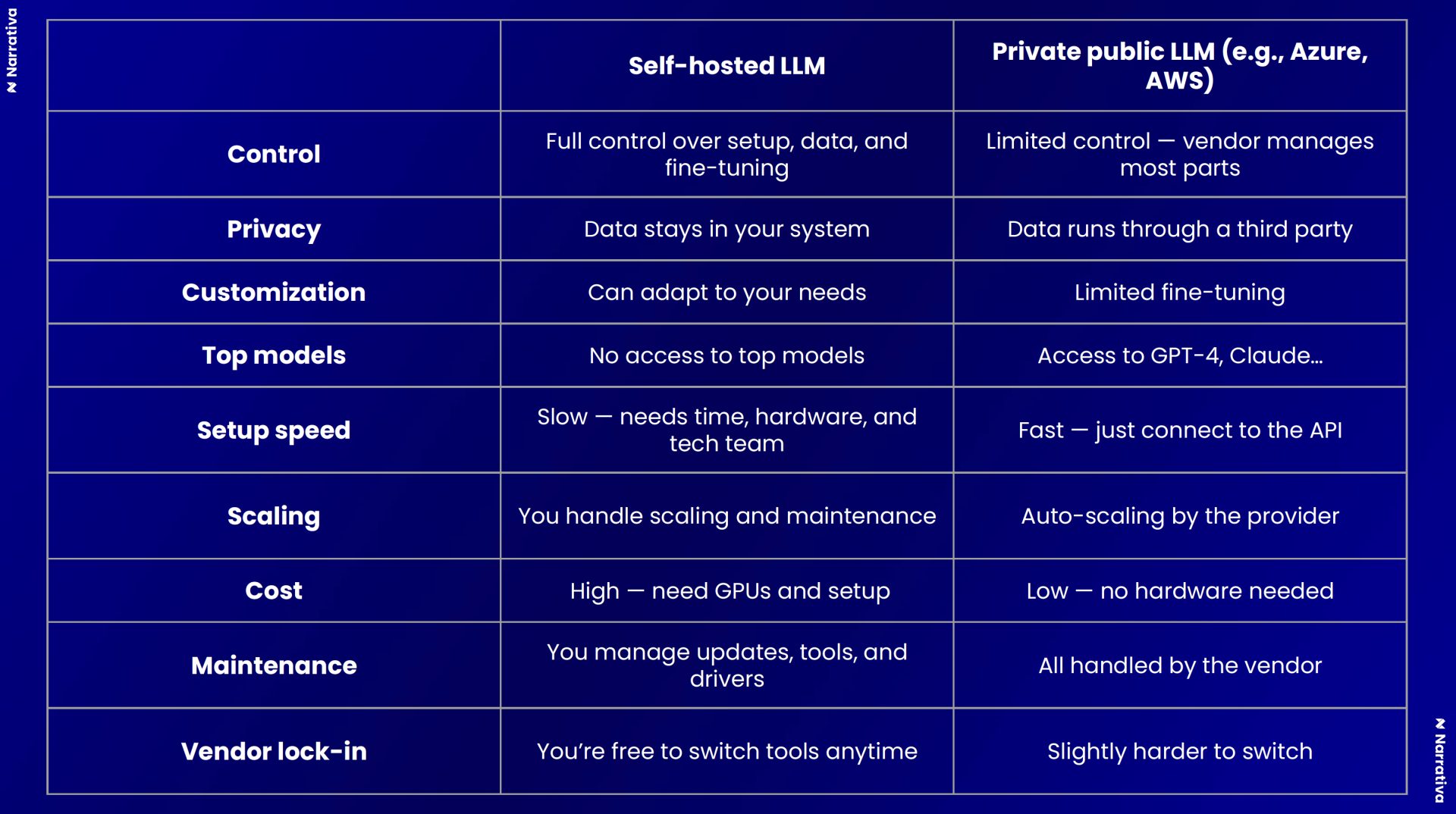
Large language models (LLMs) are becoming a key part of AI tools and applications. With that, many companies are asking themselves a big question: should we run our own model on private infrastructure, or should we use a public one like GPT-4 or Claude through AWS or Azure? Both options have their pros and cons when it comes to cost, control, scaling, and data privacy. Private LLM vs. public LLM hosting: what’s right for you?
Hosting a private LLM yourself
This means setting up and running a model on your own servers or in your cloud account. Most companies that go this route use open-source models like LLaMA, Mistral, or Deepseek.
In highly regulated sectors such as life sciences, the choice between private and public LLM hosting becomes even more important. Pharmaceutical companies, clinical research organizations, and medical writing teams often work with sensitive clinical data and regulatory documentation. In these environments, organizations must balance the benefits of advanced AI models with strict requirements around data privacy, compliance, and auditability.
Choosing the right LLM deployment strategy can therefore have a direct impact on how efficiently teams can analyze clinical data, generate regulatory documentation, and support medical research workflows.
Pros
- You’re in charge: You control how the model runs, how the data is handled, and how it’s fine-tuned.
- Better data privacy: Since everything stays in your systems, it’s easier to meet strict privacy or compliance rules.
- Custom fit: You can adjust the model to match your industry or specific use case.
- No dependency: You’re not tied to a third-party provider.
Cons
- Expensive setup: You’ll need powerful GPUs and ongoing investment in hardware, power, and maintenance.
- Harder to manage: Setting it all up and keeping it running takes a skilled technical team. Also, keeping up with the pace of innovation means regularly installing new drivers, modules, and tools to support the latest state-of-the-art models.
- Slower response times: If the hardware isn’t fast enough, latency could be an issue.
- No access to top models: Proprietary models like GPT-4 or Claude aren’t available unless open-source versions catch up.
Using a private version of a public LLM
In this case, you use services like OpenAI on Azure or Anthropic through AWS. They give you access to advanced models, often with private endpoints and region controls for better data protection.
Pros
- Best models available: You can use powerful tools like GPT-4, Claude 4, or Gemini without needing to host them.
- Fast to start: You can connect via API and be up and running quickly.
- Easy to scale: The provider handles infrastructure, updates, and load spikes.
- Built for business: Features such as logging, monitoring, SLAs, and certifications (e.g., GDPR, SOC 2) are often included.
Cons
- Limited control: You usually can’t fully fine-tune or retrain the model.
- Some data concerns: Even with private access, your data still runs through a third party.
- Costs can grow: Heavy usage might become expensive with API pricing.
- You’re tied to a vendor: Changing platforms later could be hard.
For industries with strict regulatory requirements such as healthcare, finance, or life sciences, private LLM deployments are often preferred because they provide greater control over sensitive data.
Platforms like Narrativa help organizations apply large language models to complex industry workflows. In sectors such as life sciences, AI systems can support tasks like analyzing clinical data, generating regulatory documentation, and automating medical writing processes while maintaining strict data governance standards.
How to choose the right option for your team
What’s right for you?
- Choose self-hosted if:
You need complete control over data and infrastructure, want to fine-tune or retrain models in-house, or must comply with strict data regulations.
- Choose a private instance of a public LLM if:
Your priority is fast deployment, accessing state-of-the-art models, and reducing the technical burden of infrastructure and maintenance.
About Narrativa
Narrativa Agentic AI solutions unlock a faster, smarter future for life sciences organizations, helping them to efficiently produce complex, high-volume documentation for regulatory and commercialization workflows. By automating content creation, Narrativa delivers greater speed, accuracy, and consistency—while ensuring full compliance in highly regulated environments.
Narrativa Navigator Platform provides secure and specialized Agentic AI-powered automation features. It includes complementary user-friendly tools such as the Medical Authoring Companion for CSR and Protocol generation, BioStat Developer for AI Agents for TLF generation and SDTM and ADaM dataset generation, Narrative Pathway, and Redaction Scout, which operate cohesively to transform clinical data into submission-ready documents for regulatory and commercialization. From database to delivery, pharmaceutical sponsors, biotech firms, and contract research organizations (CROs) rely on Narrativa to streamline workflows, decrease costs, and reduce time-to-market across the clinical lifecycle and, more broadly, throughout their entire businesses.
Explore www.narrativa.com and follow on LinkedIn, Facebook, Instagram, and X.