Start with approved sources
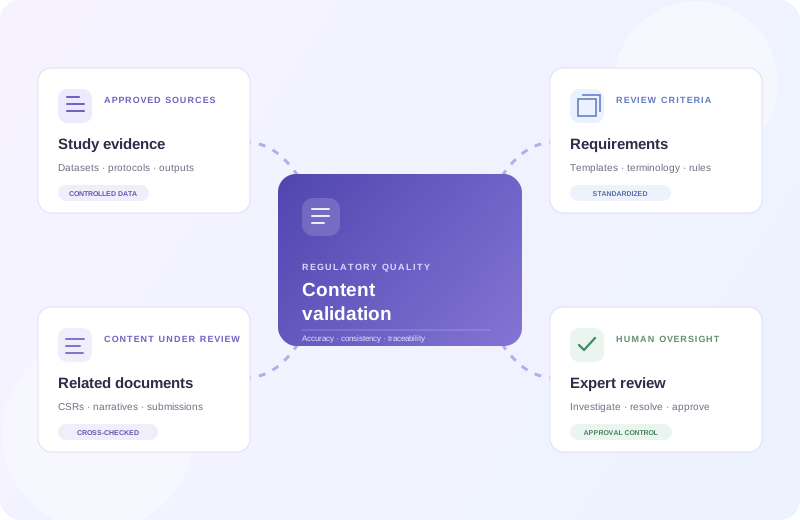
Validate against controlled datasets, protocols, statistical outputs, and reference documents selected for the workflow.

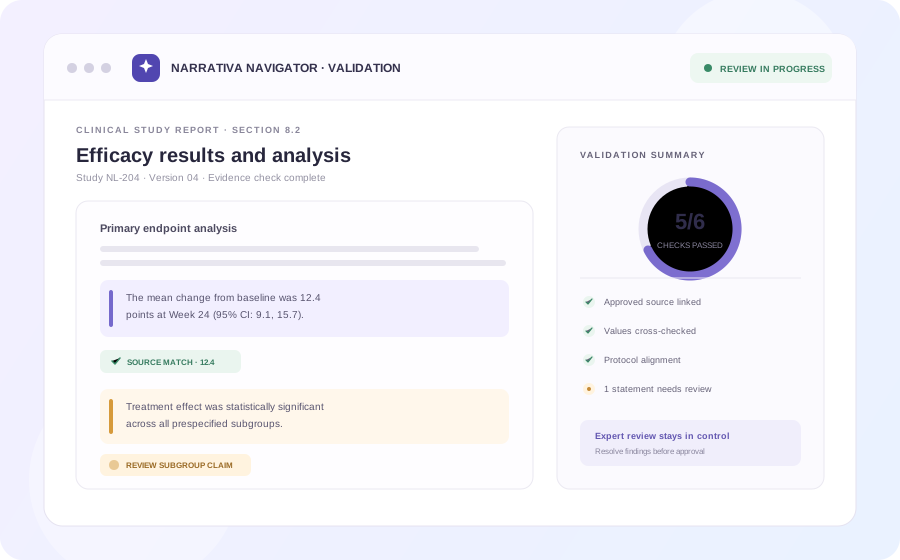
Check every claim against its source. Bring scientific accuracy, cross-document consistency, and traceability into one expert-led review workflow.
AI AGENTS TRUSTED BY LIFE SCIENCES ORGANIZATIONS
Purpose-built checks compare regulatory content with approved sources and requirements—so medical writers and subject-matter experts can focus on the findings that need judgment.
Validate against controlled datasets, protocols, statistical outputs, and reference documents selected for the workflow.
Use approved templates, terminology, prompts, and validation rules to standardize checks across studies and teams.
Check values, statistical interpretations, efficacy and safety statements, endpoints, and protocol alignment against evidence.
Find conflicting values, terminology, or conclusions across CSRs, narratives, summaries, protocols, and submission content.
Flag missing information, absent references, unsupported statements, and content outside predefined requirements.
Direct potential issues to qualified reviewers, who investigate findings, resolve queries, and approve final content.
As AI accelerates the creation of clinical study reports, patient narratives, protocols, Investigator Brochures, and submission documents, manual review can become a bottleneck. The Regulatory Content Validation Agent brings repeatable checks into the workflow, helping teams review more content without losing sight of the evidence behind it.
Findings stay connected to supporting sources so reviewers can verify statements, investigate discrepancies, and focus their expertise where it matters. Medical writers and regulatory professionals retain control of scientific interpretation, resolution, and approval.
Within Narrativa Navigator, validation is supported by controlled data sources, standardized workflows, source traceability, audit trails, version management, role-based access, and human oversight. The agent supports content validation and expert review; it does not replace formal computerized system validation or organizational quality procedures.
Understand how AI-supported validation fits into a controlled regulatory review workflow.
It reviews regulatory content against approved source data and predefined requirements to identify potential inaccuracies, inconsistencies, missing information, and unsupported statements.
Yes. The agent can support the review of AI-generated content as well as documents drafted or edited by regulatory and medical writing professionals.
It can support validation of clinical study reports, patient narratives, clinical study protocols, Investigator Brochures, safety and efficacy summaries, regulatory submission documents, eCTD content, and other clinical and regulatory materials.
Findings and statements can be connected to relevant source data or reference documents, allowing reviewers to inspect the supporting evidence and verify the content.
Yes. The agent helps accelerate and standardize validation, while qualified professionals remain responsible for scientific interpretation, regulatory judgment, resolving findings, and final approval.
No. It supports regulatory content validation and quality review. It does not replace formal computerized system validation, an organization’s quality procedures, or approval by qualified professionals.
Examples include numerical values that do not match source data, unsupported statements, inconsistencies between sections or documents, missing information or references, terminology differences, and misalignment with protocols, endpoints, statistical outputs, or approved requirements.