


CSR AI Agents
TLFs
TLF Generation
Generates Tables, Listings, and Figures (TLF) for clinical trials, streamlining the reporting process. This capability enhances the efficiency of data presentation, allowing researchers to focus on insights and outcomes rather than the technicalities of report generation.
CSR
Table to Text
Converts complex TLFs into clear, narrative prose text, facilitating easier interpretation of data. This transformation aids researchers and stakeholders in understanding findings without needing to decipher intricate tables, thereby supporting more informed decision-making.
Documents
Document Planner
Organizes and plans the creation of regulatory documents, ensuring timely and accurate submissions. By streamlining the documentation process, it reduces the risk of delays and errors, facilitating smooth compliance with regulatory requirements.
Quality Control
QC Validator
Ensures the quality and consistency of documents through automated quality control checks. This tool significantly reduces the likelihood of errors and inconsistencies, maintaining the integrity and reliability of all documentation.
Compliance
Compliance Specialist
Monitors and ensures adherence to regulatory compliance across processes and documentation. By actively overseeing compliance, it helps to prevent potential regulatory issues, ensuring all practices meet current legal and industry standards.
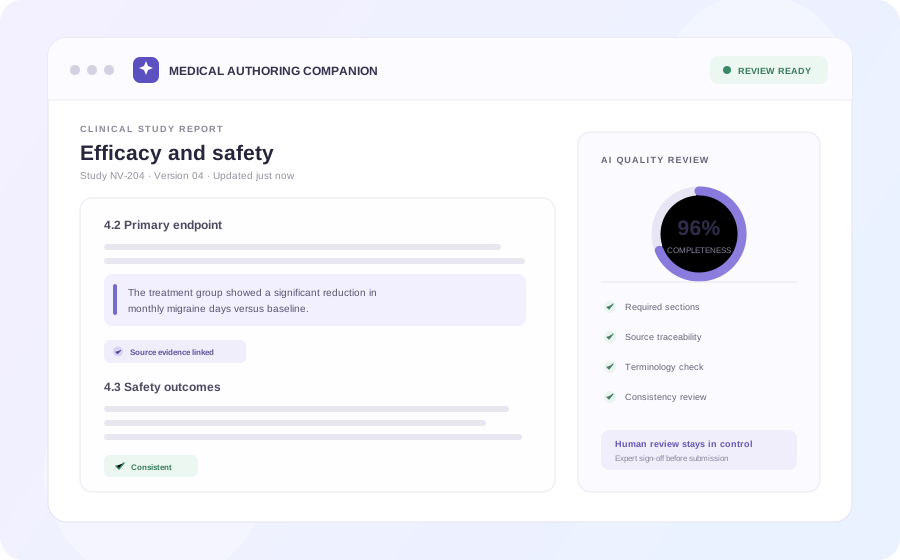
Medical Authoring Companion streamlines Clinical Study Report (CSR) development with its core AI Agents, which are designed to enhance quality and compliance throughout the process. These intelligent agents provide continuous oversight, coordinating the creation of CSRs while performing rigorous quality control checks to identify and rectify errors at an early stage.
Learn more: CSR agentic AI automation
The pharmaceutical industry is undergoing a data revolution, with AI playing a pivotal role in transforming raw data into actionable insights. Traditionally, empirical analysis has been the foundation for identifying patterns, testing hypotheses, and evaluating treatment efficacy. Now, AI is set to amplify this process, enabling faster knowledge dissemination and regulatory compliance.
Automation of clinical report writing
Medical Authoring Companion enables pharmaceutical companies to automate the creation of Clinical Study Reports (CSRs), streamlining workflows, reducing costs, and ensuring regulatory compliance. By minimizing human error and cutting down on review cycles, this AI-powered tool enhances overall efficiency. Medical Authoring Companion supports key use cases such as the integration of Tables, Listings, and Figures (TLFs) and patient safety narratives, significantly reducing the manual workload for medical writing teams.
How does CSR Automation work?
Medical Authoring Companion automates the writing of Clinical Study Reports by extracting data directly from Tables, Listings, and Figures (TLFs) and ADaM datasets, converting them into clear, structured narrative text. Instead of manually reviewing complex tables, the AI processes TLFs from multiple formats, maps the data into the Narrativa Knowledge Graph, and generates accurate, submission-ready prose—saving time and reducing errors.
Medical Authoring Companion supports both system-generated and user-defined prompts, allowing for flexible, high-quality content tailored to specific reporting needs.
Traceability and validation
Since Medical Authoring Companion generates the initial draft, medical writers are responsible for reviewing and validating the content for accuracy.
To support this, the platform allows users to click on any data point in the narrative and instantly trace it back to its source in the original table or dataset. This feature simplifies the quality assurance process, enabling fast, precise verification and edits while keeping full editorial control with the medical writer.
Narrativa Knowledge Graph®
The Narrativa Knowledge Graph® integrates various data management methodologies, including:
Interlinked Databases: Providing structured entity descriptions.
Semantic Knowledge Bases: Enabling data interpretation and inference.
By combining deep learning with knowledge graphs, Narrativa can process vast datasets, extract key insights, and generate contextualized reports.
Advanced Statistical and Analytical Integration
Narrativa’s CSR Automation solution incorporates:
Statistical testing for hypothesis validation
Confidence interval calculations
Risk assessments (relative risk, risk ratios)
Frequentist and data augmentation techniques
More features: variability and rich language
Narrativa’s CSR automation solution is designed to generate high-quality content with ease. By training on a provided corpus, the system adapts to each organization’s preferred writing style, producing narratives with rich language and variability when needed.
Using deep learning, the platform extracts key topics, synonyms, and sentence structures from large volumes of clinical trial data to mimic the desired tone and format. Users retain full control over the output, with the ability to refine text as needed through an iterative process.
This approach reflects Narrativa’s mission to apply AI responsibly—turning complex clinical data into clear, compliant documentation that serves both science and society.
Overcoming regulatory compliance challenges
Optimize operational efficiency
Reduce costs and manual workload
Reallocate resources to higher-value research and development activities
By embracing AI-driven CSR automation, the pharmaceutical industry can expedite drug development, improve regulatory submissions, and ultimately enhance patient outcomes.