

Clinical trial timelines can significantly influence where pharmaceutical companies choose to conduct research, how they allocate resources, and when new treatments reach patients. For companies managing multinational studies, understanding the regulatory requirements of different jurisdictions is essential to developing an effective clinical trial strategy.
However, clinical trial approval timelines vary considerably between the United States, European Union, United Kingdom, and China, and the differences are not always straightforward.
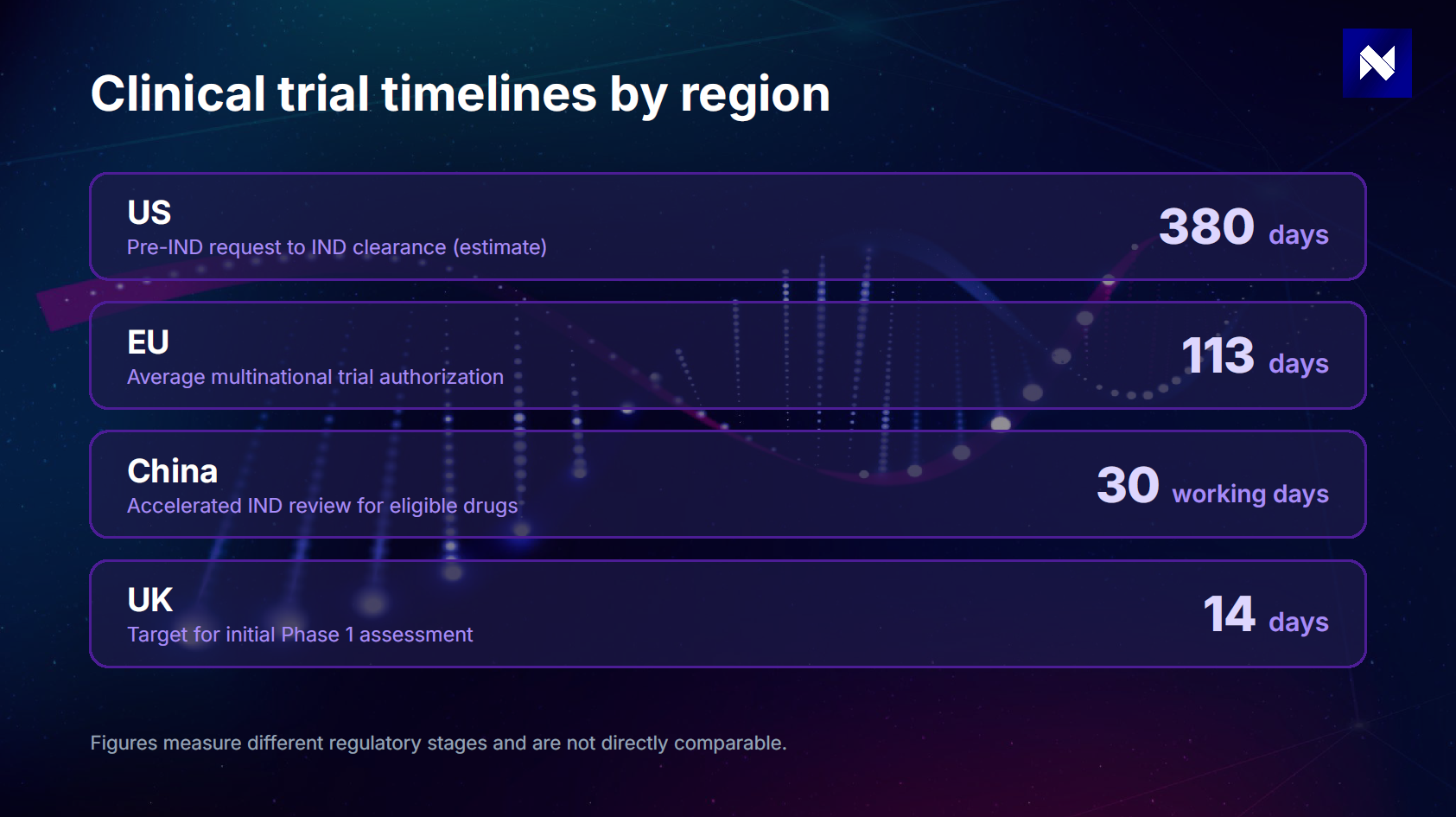
Recent figures suggest approximately 380 days from the initial pre-IND request to IND clearance in the US, compared with around 220 days in China. Meanwhile, the European Commission reports an average of 113 days to authorize multinational clinical trials, while the UK’s Medicines and Healthcare products Regulatory Agency (MHRA) has introduced a target of just 14 days for the initial assessment of certain Phase 1 trials.
These numbers may appear to reveal dramatic differences in regulatory efficiency, but they measure different stages of the clinical development process. Understanding what each timeline represents is essential before drawing conclusions or making decisions about trial locations.
Clinical trial approval timelines: US vs EU vs UK vs China
The following table summarizes key regulatory timelines and recent developments across the four regions.
| Region | Timeline | What it measures |
|---|---|---|
| United States | Approximately 380 days | Pre-IND request to IND clearance |
| China | Approximately 220 days | Pre-IND request to IND clearance |
| China | 30 working days | Accelerated IND review for eligible innovative drugs |
| European Union | 113 days | Average authorization time for multinational clinical trials |
| United Kingdom | 14 days | MHRA target for initial assessment of qualifying Phase 1 trials |
These figures are drawn from different reporting periods and regulatory processes. They should not be interpreted as directly comparable measures of total clinical trial startup time.
Regulatory authorization is also only one component of trial initiation. Ethics approvals, site selection, contractual arrangements, operational preparation, and patient recruitment can all influence when a study actually begins.
For multinational sponsors, the challenge is therefore not simply identifying the jurisdiction with the shortest regulatory review period. It is understanding how each country’s requirements fit into the broader clinical development plan.
Clinical trial approval timelines in the United States
The United States remains a major destination for pharmaceutical research, but the time required to move from early regulatory engagement to clinical trial authorization has become an important policy concern.
According to figures cited by then-FDA Commissioner Marty Makary, the US takes approximately 380 days from the initial pre-Investigational New Drug (IND) request to IND clearance, compared with around 220 days in China.
As reported by Cooley in July 2026, Makary also highlighted that China had recorded approximately four times as many Phase 1 clinical trial initiations as the US since at least 2024.
These figures have intensified discussions about how the FDA can reduce administrative delays and strengthen the country’s competitiveness in early-stage drug development.
The FDA’s expedited IND pilot program
One response is an expedited IND pilot designed to accelerate the initiation of certain clinical trials.
According to Clinical Trials Arena, applications closed on October 30, 2026, with an estimated eight to ten sponsor and qualified research institution (QRI) pairs expected to participate.
The initiative aims to explore whether closer coordination and more efficient regulatory processes can reduce the time required to begin clinical development.
The same report cites an analysis by Deallus indicating that the average Phase 1 clinical trial lasts approximately seven months in China, compared with 17 months in the United States. Importantly, these figures describe trial duration rather than regulatory approval time.
Officials have suggested that the expedited IND initiative could potentially reduce development timelines by six to twelve months. However, as discussed by Pharmaceutical Executive, this remains a policy objective rather than a demonstrated outcome.
For pharmaceutical companies, the pilot represents a development worth monitoring, but its impact on future clinical trial startup timelines will depend on implementation and measurable results.
Clinical trial approval timelines in the European Union
The European Union faces a different challenge: coordinating clinical trial authorization across multiple Member States while maintaining consistent regulatory and scientific standards.
According to European Commission figures discussed by Sidley, multinational clinical trials take approximately 113 days on average to receive authorization in the EU, compared with fewer than 60 days for the approval processes referenced in the US and China.
This comparison concerns authorization timelines, not the longer pre-IND-to-clearance period cited earlier for the US.
The EU’s Clinical Trials Regulation and Clinical Trials Information System (CTIS) provide a harmonized framework for submitting and assessing clinical trial applications. Nevertheless, multinational studies still require coordination between national authorities, ethics bodies, and participating countries.
Could the EU Biotech Act accelerate clinical trial approvals?
The proposed EU Biotech Act aims to improve Europe’s competitiveness in biotechnology, including by simplifying aspects of clinical trial authorization.
As outlined by Covington, the European Commission’s proposal includes measures intended to reduce the authorization timeline for multinational clinical trials from 106 to 75 days.
The 106-day figure used in the legislative proposal should not be confused with the separately reported 113-day average.
As of November 2026, the Biotech Act remains under legislative consideration. Parliamentary committee votes are expected in December 2026, while further Council negotiations could extend into 2027.
Although implementation in late 2027 or early 2028 has been discussed as a possibility, these dates remain uncertain. Pharmaceutical companies should therefore distinguish between existing requirements and proposed regulatory improvements when developing their clinical trial plans.
ICH E6(R3) and evolving GCP requirements
Beyond approval timelines, European clinical research is also adapting to updated Good Clinical Practice (GCP) expectations.
The European Medicines Agency identifies January 15, 2027, as the effective date for ICH E6(R3) Annex 2 in the EU.
Annex 2 provides additional considerations for clinical trials incorporating decentralized elements, pragmatic approaches, and real-world data.
Although these provisions do not directly establish shorter authorization timelines, they reinforce the importance of appropriate data governance, documentation, oversight, and quality management across increasingly complex clinical research environments.
Clinical trial approval timelines in the United Kingdom
The United Kingdom is also pursuing regulatory modernization, with particular attention to early-stage clinical development and innovative medicines.
In October 2026, the MHRA announced its strategy for 2030, outlining measures intended to make the UK a more attractive environment for clinical research.
Among the most notable objectives is a 14-day initial assessment target for qualifying Phase 1 clinical trials, representing a reduction from the previous 28-day target.
The strategy also introduces a fast-track scientific advice pathway intended to reduce the relevant timeline from 90 to 45 days.
These commitments, described in the MHRA’s 2030 strategy announcement, reflect a broader effort to modernize regulatory processes and support innovative drug development.
However, the 14-day figure refers specifically to an initial assessment for qualifying studies. It does not represent the complete time required to obtain every necessary approval or initiate a clinical trial.
Similarly, the 45-day scientific advice target concerns a separate regulatory activity and should not be interpreted as a clinical trial authorization deadline.
For sponsors considering the UK as a location for first-in-human studies, these initiatives may offer opportunities to improve development planning. Their practical significance will depend on eligibility criteria, implementation, and the MHRA’s ability to meet its stated targets consistently.
Clinical trial approval timelines in China
China has introduced regulatory measures intended to accelerate innovative drug development and strengthen its position in global clinical research.
Under the standard framework, the National Medical Products Administration (NMPA) operates a 60-working-day IND review period.
However, a new accelerated pathway introduced in September 2025 provides a shorter review period for certain eligible innovative medicines.
China’s 30-working-day IND review pathway
Under NMPA Announcement No. 86, effective September 9, 2025, qualifying Class 1 innovative drugs may receive an IND review within 30 working days of application acceptance.
According to the NMPA’s official announcement, the pathway covers specific categories of innovative drug development, including nationally supported projects, eligible pediatric and rare disease treatments, certain traditional Chinese medicine products, and products developed through globally synchronized clinical programs.
Eligibility depends on the type of medicine and the proposed clinical development strategy.
For globally synchronized development programs, Phase 1 and Phase 2 studies may qualify under the applicable conditions. For Phase 3 multiregional clinical trials, the pathway requires a principal investigator from a Chinese institution to serve as the lead or co-lead investigator.
The accelerated review period is also subject to important limitations. If the assessment cannot be completed within 30 working days, the review may extend to the standard 60-working-day period.
In addition, sponsors must commit to initiating the clinical trial within 12 weeks of receiving approval.
These conditions demonstrate that China’s accelerated pathway is not a universal 30-day authorization process. It is a targeted regulatory mechanism intended to support specific categories of innovative medicines and development programs.
For multinational pharmaceutical companies, determining whether a study qualifies requires careful assessment of the product classification, trial phase, development strategy, and local regulatory requirements.
What do different clinical trial timelines mean for multinational studies?
Regulatory reforms across the US, EU, UK, and China share a common objective: making clinical development more efficient without compromising patient safety or scientific standards.
However, shorter review periods do not automatically translate into faster clinical trials.
A multinational study must navigate several regulatory frameworks, often involving different submission requirements, review procedures, documentation expectations, and operational dependencies.
A delay in one jurisdiction may affect site activation, recruitment planning, resource allocation, or the coordination of activities across participating countries.
For this reason, pharmaceutical companies need to evaluate regulatory timelines alongside the operational readiness of their clinical development programs.
Why regulatory documentation matters more as timelines accelerate
As regulatory authorities introduce shorter review targets, the ability to prepare complete, accurate, and consistent submission documentation becomes increasingly important.
Clinical trial applications depend on information distributed across multiple documents, including study protocols, Investigator’s Brochures, supporting scientific documentation, and other regulatory materials.
These documents must communicate consistent information about the investigational product, study design, safety considerations, and clinical development strategy.
When discrepancies arise between documents, resolving them may require additional review, clarification, or revision. In multinational studies, the challenge becomes more complex because information must remain aligned across different submissions and regulatory jurisdictions.
Identifying inconsistencies before submission can help reduce avoidable rework and improve the efficiency of regulatory preparation.
This is where agentic AI can support regulatory documentation workflows.
At Narrativa, AI agents can assist with drafting regulatory documents using study-specific information, cross-referencing content, identifying potential inconsistencies, and maintaining traceability between statements and their underlying sources.
Rather than replacing regulatory expertise, these capabilities support medical writers and regulatory affairs professionals in managing complex documentation processes. Qualified professionals remain responsible for evaluating, reviewing, and approving the final content.
As clinical trial authorization processes evolve, organizations that combine regulatory expertise with reliable documentation workflows will be better positioned to respond to changing requirements.
To explore how agentic AI can support your regulatory documentation processes, book a demo with Narrativa.
Preparing for the future of global clinical trials
The regulatory environment for clinical trials is changing across major pharmaceutical markets. The FDA is exploring accelerated IND processes, the EU is considering legislative reforms, the MHRA has established ambitious assessment targets, and China has introduced a faster pathway for selected innovative medicines.
These developments reflect a growing international emphasis on reducing unnecessary delays in clinical development.
Yet the most important consideration for pharmaceutical companies is not which jurisdiction reports the shortest review period. It is how regulatory requirements, documentation readiness, and operational planning work together to support efficient multinational studies.
Faster regulatory reviews create opportunities, but realizing those opportunities requires preparation well before an application reaches the regulator.
For organizations conducting global clinical trials, understanding the differences between regulatory timelines and investing in consistent, traceable documentation are essential steps toward more predictable and efficient clinical development.
Frequently asked questions about clinical trial approval timelines
Which country has the fastest clinical trial approval process?
There is no single answer because regulatory timelines measure different stages of clinical trial authorization. China offers a 30-working-day review pathway for eligible innovative drugs, while the UK has established a 14-day initial assessment target for certain Phase 1 trials. Neither figure represents the complete clinical trial startup process.
How long does it take to start a clinical trial in the US?
Figures cited by former FDA Commissioner Marty Makary indicate approximately 380 days from the initial pre-IND request to IND clearance. This is a broader development interval, not the FDA’s standard IND review period.
How long does clinical trial approval take in the EU?
European Commission figures indicate an average of approximately 113 days for multinational clinical trial authorization. The proposed EU Biotech Act includes measures intended to shorten certain authorization timelines, but these changes have not yet entered into force.
Does China’s 30-day IND review apply to all clinical trials?
No. The accelerated pathway applies only to eligible innovative drugs meeting the conditions established by the NMPA. Other applications remain subject to the standard regulatory framework.
When does ICH E6(R3) Annex 2 take effect in the EU?
ICH E6(R3) Annex 2 is scheduled to take effect in the European Union on January 15, 2027. It provides additional GCP considerations for trials incorporating decentralized elements, pragmatic approaches, and real-world data.
About Narrativa
Narrativa Agentic AI solutions unlock a faster, smarter future for life sciences organizations, helping them to efficiently produce complex, high-volume documentation for regulatory and commercialization workflows. By automating content creation, Narrativa delivers greater speed, accuracy, and consistency—while ensuring full compliance in highly regulated environments.
Narrativa Navigator Platform provides secure and specialized Agentic AI-powered automation features. It includes complementary user-friendly tools such as the Medical Authoring Companion for CSR and Protocol generation, BioStat Developer for AI Agents for TLF generation and SDTM and ADaM dataset generation, Narrative Pathway, and Redaction Scout, which operate cohesively to transform clinical data into submission-ready documents for regulatory and commercialization. From database to delivery, pharmaceutical sponsors, biotech firms, and contract research organizations (CROs) rely on Narrativa to streamline workflows, decrease costs, and reduce time-to-market across the clinical lifecycle and, more broadly, throughout their entire businesses.
Explore www.narrativa.com and follow on LinkedIn, Facebook, Instagram, and X.