

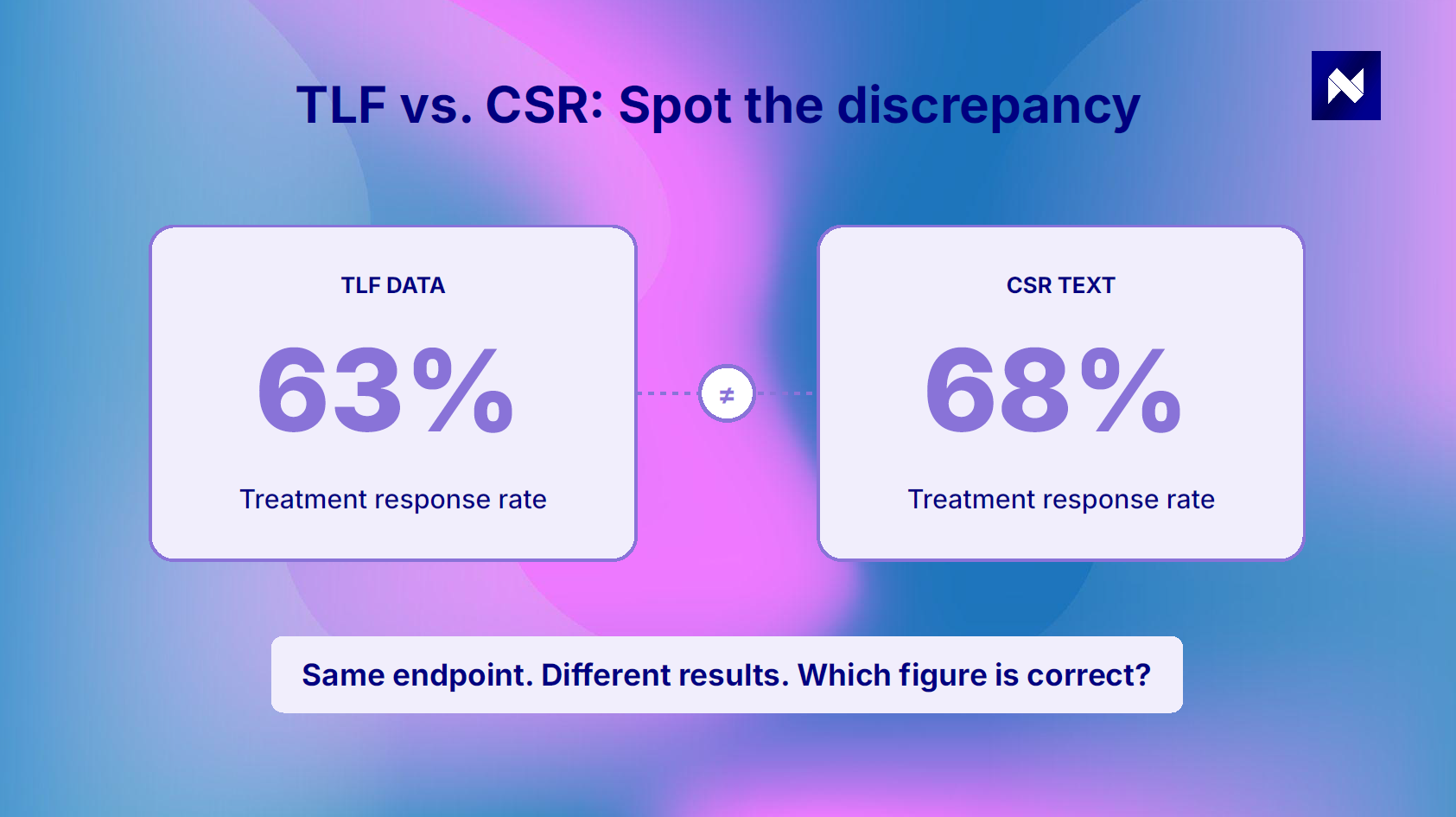
A Clinical Study Report (CSR) states that 68% of patients achieved the primary efficacy endpoint. However, the corresponding statistical table reports a response rate of 63%.
Which figure is correct?
The difference may result from an outdated statistical output, an incorrect denominator, a transcription error, or the use of different analysis populations. Regardless of the cause, the discrepancy must be investigated before the CSR is finalized.
Consistency between Tables, Listings and Figures (TLFs) and CSR narratives is essential for accurate clinical reporting. Even minor discrepancies can affect the interpretation of study results, complicate quality control, and generate questions during regulatory review.
Identifying these inconsistencies requires more than checking numerical values. It involves verifying the relationship between statistical outputs, source data, analysis specifications, and the conclusions presented in the CSR.
Understanding the relationship between TLFs and CSR text
TLFs provide the statistical evidence supporting the results described in a Clinical Study Report. They summarize information about patient disposition, baseline characteristics, efficacy endpoints, safety outcomes, and other study findings.
The CSR transforms these results into a structured scientific narrative, explaining the findings and their clinical relevance.
According to ICH E3: Structure and Content of Clinical Study Reports, clinical study reports should present study methodology, results, and analyses in sufficient detail to support regulatory evaluation.
Maintaining consistency requires alignment across several sources:
- Statistical Analysis Plan (SAP): Defines planned analyses, endpoints, populations, and statistical methods.
- Analysis datasets: Provide the data used to generate statistical outputs.
- TLFs: Present statistical results in tables, listings, and figures.
- CSR narratives: Describe and interpret those results for regulatory reviewers.
A discrepancy may arise at any point in this process. For example, a statistical table may be regenerated following a data correction while the corresponding CSR paragraph remains unchanged.
Therefore, TLF-to-CSR reconciliation should verify not only whether values match, but also whether the underlying analysis context is consistent.
The most common discrepancies between TLFs and CSR narratives
Understanding the different types of discrepancies helps clinical teams develop more effective verification procedures.
1. Numerical inconsistencies
These occur when numerical values in the CSR differ from those in the corresponding TLF.
For example, a safety table reports that 42 of 120 patients (35.0%) experienced treatment-related adverse events, while the CSR states 38 patients (31.7%).
Potential causes include transcription errors, outdated results, incorrect denominators, or inconsistent rounding conventions.
Reviewers should verify both the reported value and the population used to calculate it.
2. Analysis population mismatches
Clinical studies frequently use different analysis populations, such as intention-to-treat (ITT), modified intention-to-treat (mITT), per-protocol, and safety populations.
A CSR may describe efficacy results from the ITT population while inadvertently referencing a table based on the per-protocol population.
Even when the reported percentages appear similar, differences in population definitions can materially affect the interpretation of the results.
3. Statistical interpretation errors
A discrepancy does not always involve an incorrect number.
For example, a CSR may describe a treatment effect as statistically significant when the corresponding analysis reports a p-value of 0.08 against a prespecified two-sided significance threshold of 0.05.
Other problems include incorrectly reported confidence intervals, effect estimates, or statements that fail to account for multiplicity adjustments.
These inconsistencies require statistical interpretation rather than simple numerical comparison.
4. Missing or incomplete results
A TLF may contain relevant findings that are omitted from the CSR narrative.
For example, a safety table may identify a clinically important imbalance in adverse events between treatment groups, but the CSR discussion may not address it.
Not every result requires extensive narrative discussion. However, omissions that affect the balanced presentation or interpretation of study findings should be investigated.
5. Terminology and timepoint inconsistencies
Differences in endpoint terminology, treatment group labels, visit names, or assessment periods can create ambiguity.
For instance, a table may report the change from baseline at Week 24, while the CSR describes the result as occurring at Week 12.
These discrepancies can be particularly difficult to identify when the numerical values are plausible in both contexts.
6. Version control discrepancies
Statistical outputs may be updated following database corrections, programming changes, or revised analysis specifications.
If the CSR references an earlier TLF version, previously accurate statements may become inconsistent with the approved results.
Effective version control is therefore an essential component of clinical reporting quality assurance.
7. Narrative interpretation discrepancies
A CSR may accurately reproduce a numerical result while overstating its clinical implications.
For example, a descriptive difference between treatment groups may be presented as evidence of superiority without an appropriate prespecified statistical comparison.
As emphasized by ICH E9: Statistical Principles for Clinical Trials, statistical methods and interpretation must be considered within the design and objectives of the clinical study.
Numerical accuracy alone does not guarantee scientific accuracy.
How to identify discrepancies between TLFs and CSR text: A step-by-step approach
A systematic reconciliation process helps teams identify inconsistencies before they affect final clinical documentation.
Step 1. Confirm the approved source versions
Before comparing results, establish which statistical outputs and supporting documents are authoritative.
Verify the SAP version, analysis dataset release, data cut-off date, TLF generation date, and applicable analysis populations.
A comparison between mismatched document versions can generate false discrepancies or overlook genuine ones.
Step 2. Map CSR statements to their statistical sources
Identify the TLF supporting each relevant numerical or interpretive statement in the CSR.
For example, a paragraph describing overall survival should be linked to the corresponding survival analysis outputs, including the applicable population, analysis timepoint, and statistical method.
Maintaining a structured mapping between CSR sections and source outputs makes discrepancies easier to investigate and supports traceability.
Step 3. Verify numerical values and denominators
Compare reported values against their source tables, including:
- Patient counts and percentages.
- Means, medians, standard deviations, and ranges.
- Hazard ratios, odds ratios, and other effect estimates.
- Confidence intervals and p-values.
- Treatment group totals and analysis denominators.
Apply the study’s approved rounding and reporting conventions. A difference between 24.6% and 25% may be acceptable rounding, whereas a difference caused by using the wrong denominator requires correction.
Step 4. Check populations, endpoints, and timepoints
Numerical values should always be interpreted within their analytical context.
Verify that each CSR statement refers to the correct treatment group, analysis population, endpoint definition, assessment visit, and analysis period.
For example, a result calculated for the safety population should not be presented as an ITT result simply because the numerical values are similar.
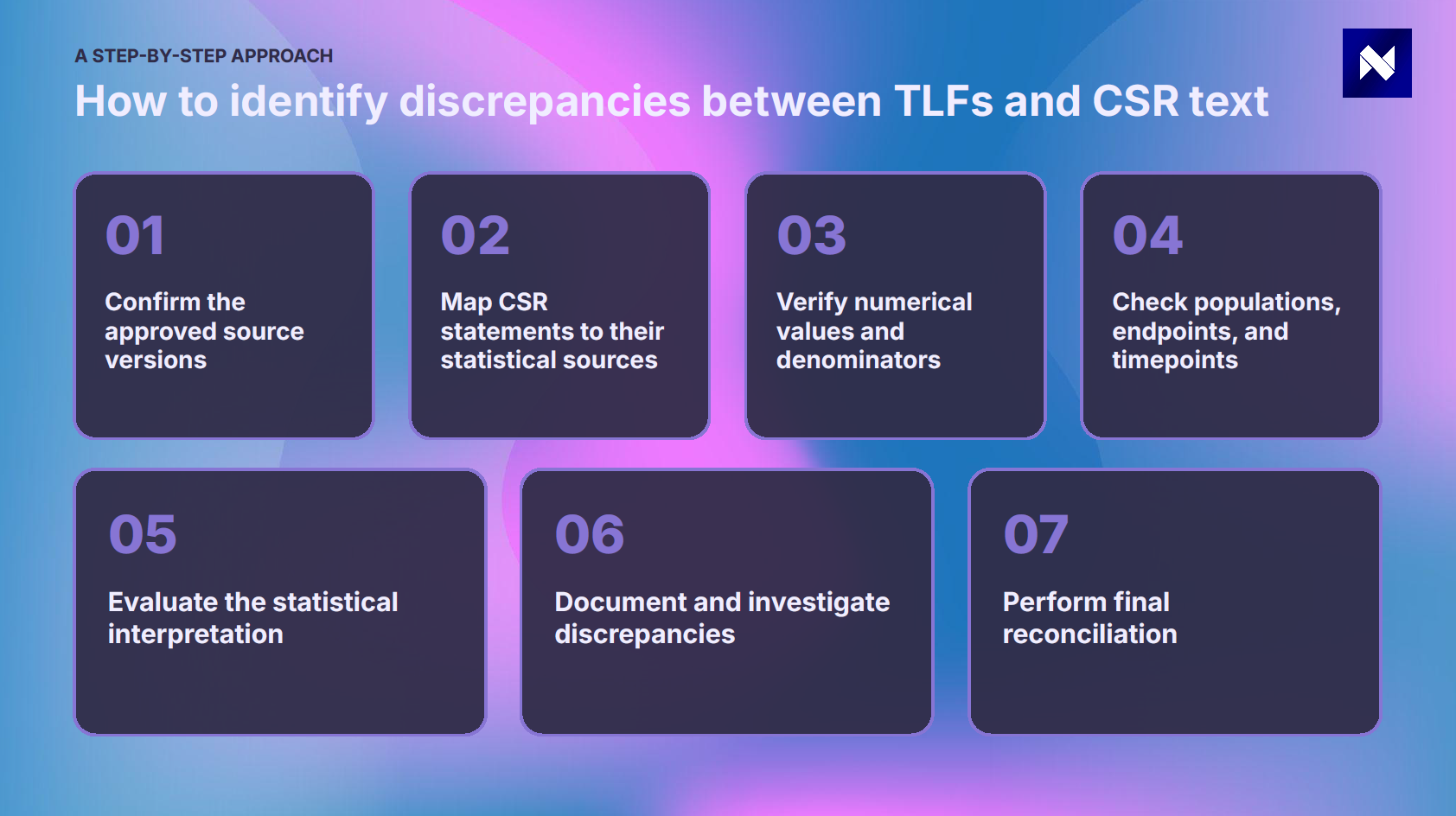
Step 5. Evaluate the statistical interpretation
Review whether the narrative accurately represents the statistical evidence.
Consider whether claims of treatment benefit are supported by the analysis, whether uncertainty is appropriately communicated, and whether limitations are acknowledged.
For estimand-related interpretation, ICH E9(R1) provides additional principles concerning treatment effects, intercurrent events, and sensitivity analyses.
Step 6. Document and investigate discrepancies
Each identified discrepancy should be recorded in a structured review log.
The record should capture the CSR location, corresponding TLF, discrepancy description, severity or potential impact, responsible reviewer, corrective action, and resolution status.
Medical writers typically coordinate narrative corrections, while statisticians and statistical programmers investigate analytical inconsistencies. Clinical data management and quality assurance teams may also participate, depending on the underlying issue.
Importantly, the TLF should not automatically be treated as correct. The discrepancy must be assessed against the approved data and analysis specifications.
Step 7. Perform final reconciliation
After corrections are implemented, repeat the relevant checks to confirm that the discrepancy has been resolved.
Changes should also be assessed for downstream effects. Correcting a patient count in one section may require updating related percentages, summary statements, tables, or conclusions elsewhere in the CSR.
Practical examples of TLF-to-CSR discrepancies
The following hypothetical examples illustrate common inconsistencies and the appropriate verification approach.
| CSR statement | TLF result | Discrepancy | Recommended action |
|---|---|---|---|
| Treatment response rate was 68%. | Response rate: 63%. | Numerical mismatch | Verify population, denominator, data cut-off, and source version. |
| 35 patients experienced serious adverse events. | 39 patients experienced serious adverse events. | Safety count mismatch | Reconcile event and patient counts, population definitions, and reporting period. |
| 180 patients completed treatment. | 172 patients completed treatment. | Patient disposition mismatch | Verify completion definitions and disposition records. |
| Treatment demonstrated statistical superiority. | Nominal p-value = 0.08. | Unsupported statistical claim | Review the prespecified hypothesis, multiplicity strategy, and statistical interpretation. |
| Mean change at Week 12 was −4.2. | Mean change at Week 24 was −4.2. | Timepoint mismatch | Verify the endpoint and visit mapping before correcting the narrative. |
All values are illustrative and do not represent actual clinical trial results.
These examples demonstrate why effective reconciliation must consider both numerical differences and contextual inconsistencies.
A matching value can still be incorrect if it refers to the wrong population, endpoint, or assessment period.
Why manual TLF-to-CSR cross-referencing becomes challenging
A single CSR may reference hundreds of statistical results across efficacy, safety, patient disposition, and exploratory analyses.
Some results appear repeatedly in the synopsis, main results sections, discussion, and conclusions. When a statistical output changes, every related statement may need to be reviewed.
Traditional reconciliation often involves manually navigating spreadsheets, statistical output files, and document versions. This creates several operational challenges.
First, the relationship between source results and narrative statements is not always explicit. A medical writer may need to search multiple outputs to determine which analysis supports a particular claim.
Second, statistical updates can introduce inconsistencies across documents. A corrected TLF may affect several CSR sections, making comprehensive impact assessment difficult.
Third, numerical comparisons alone cannot identify every discrepancy. Determining whether a narrative accurately describes a statistical finding often requires scientific judgment and contextual understanding.
These challenges become more significant when multiple teams contribute to the same report under tight regulatory submission timelines.
How agentic AI can support TLF-to-CSR verification
Agentic AI introduces opportunities to make clinical document verification more systematic, particularly when workflows involve large volumes of interconnected statistical and narrative content.
Rather than relying exclusively on manual searches, appropriately designed AI-assisted workflows can help identify relationships between documents, compare information, and prioritize potential discrepancies for review.
Automated extraction and cross-referencing
AI-powered systems can be designed to extract numerical values, endpoint names, treatment groups, analysis populations, and timepoints from structured and semi-structured statistical outputs.
They can then identify corresponding statements in CSR narratives, creating mappings between reported findings and supporting evidence.
For example, an AI agent could locate a paragraph describing treatment-emergent adverse events, identify the relevant safety table, and compare the reported patient counts and percentages.
Detecting numerical and contextual inconsistencies
Automated verification can combine two complementary approaches.
Deterministic validation uses explicit rules to compare numerical values, calculate percentages, apply rounding conventions, and verify expected relationships.
AI-assisted semantic validation evaluates whether narrative statements correspond to the appropriate endpoint, population, timepoint, and statistical interpretation.
This distinction is important. Two statements may contain identical numbers while referring to different analyses, and two correctly rounded values may differ without representing a genuine discrepancy.
Supporting traceability and review workflows
AI-assisted systems can also help organize discrepancies into structured review records, linking flagged statements to their supporting outputs.
Where implemented with appropriate controls, these workflows can support source traceability, version identification, reviewer assignments, and documentation of corrective actions.
However, automated checks have limitations. Ambiguous source mappings, complex statistical methods, inconsistent document formatting, and incomplete contextual information can produce false positives or missed discrepancies.
Human oversight remains essential. Qualified medical writers, statisticians, and clinical reviewers must evaluate flagged findings and approve corrections.
At Narrativa®, our approach to agentic AI focuses on supporting clinical and regulatory documentation workflows through automation and human oversight. Applying these principles to cross-referencing and quality control can help teams manage complex documentation processes while preserving the scientific judgment required in regulated environments.
Best practices for maintaining CSR data consistency
Organizations can strengthen TLF-to-CSR reconciliation by incorporating verification activities throughout CSR development rather than treating them as a final-stage task.
- Establish a single source of truth. Maintain controlled, approved versions of statistical outputs and supporting analysis documentation. Ensure that reviewers know which sources are authoritative.
- Standardize terminology and reporting conventions. Use consistent endpoint names, treatment group labels, population definitions, and rounding rules across statistical outputs and narratives.
- Maintain source-to-narrative traceability. Link important CSR statements to their corresponding TLFs, including identifiers, versions, and relevant analytical context.
- Integrate verification into document development. Perform reconciliation at defined milestones, particularly following statistical updates or substantial narrative revisions.
- Apply risk-based quality control. Prioritize critical efficacy endpoints, major safety findings, primary statistical conclusions, and other information with a potentially significant impact on regulatory interpretation.
- Document discrepancies and their resolution. Maintain an auditable record of identified issues, investigations, corrective actions, and reviewer approvals.
These practices support a more consistent and defensible clinical reporting process, whether reconciliation is performed manually or with AI assistance.
Conclusion
Identifying discrepancies between TLFs and CSR text requires more than comparing numbers. It involves verifying statistical context, analysis populations, source versions, and the scientific interpretation of clinical results.
A structured reconciliation process helps medical writers, statisticians, and regulatory teams detect inconsistencies, investigate their causes, and maintain reliable documentation.
As clinical reporting workflows become more complex, AI-assisted cross-referencing offers opportunities to reduce repetitive verification tasks and improve visibility into relationships between statistical outputs and regulatory narratives.
Combining automated checks with qualified human review can help organizations strengthen document quality while maintaining appropriate scientific and regulatory oversight.
Discover how Narrativa supports AI-powered clinical and regulatory documentation workflows.
Frequently asked questions
What is TLF-to-CSR reconciliation?
TLF-to-CSR reconciliation is the process of verifying that the numerical results, analysis populations, endpoints, and statistical interpretations presented in a Clinical Study Report are consistent with the corresponding Tables, Listings and Figures and approved analysis specifications.
What are the most common discrepancies between TLFs and CSR text?
Common discrepancies include incorrect patient counts, mismatched percentages, inconsistent analysis populations, outdated statistical results, incorrect timepoints, and narrative conclusions that do not accurately reflect the underlying analyses.
Can AI automatically identify discrepancies between TLFs and CSR narratives?
AI-assisted systems can identify potential numerical, contextual, and semantic inconsistencies. However, detection accuracy depends on source quality, document structure, validation rules, and the system’s capabilities. Qualified reviewers remain responsible for investigating discrepancies and approving corrections.
Why is traceability important in Clinical Study Report quality control?
Traceability enables reviewers to identify the statistical evidence supporting each CSR statement. It facilitates discrepancy investigation, change impact assessment, and verification that the final narrative accurately represents the approved analyses.
Does ICH E3 require automated TLF-to-CSR reconciliation?
No. ICH E3 provides guidance on the structure and content of Clinical Study Reports, but does not prescribe automated reconciliation technology. Systematic cross-referencing is a quality control practice that helps support the guideline’s objectives for complete, accurate, and interpretable reporting.
About Narrativa
Narrativa Agentic AI solutions unlock a faster, smarter future for life sciences organizations, helping them to efficiently produce complex, high-volume documentation for regulatory and commercialization workflows. By automating content creation, Narrativa delivers greater speed, accuracy, and consistency—while ensuring full compliance in highly regulated environments.
Narrativa Navigator Platform provides secure and specialized Agentic AI-powered automation features. It includes complementary user-friendly tools such as the Medical Authoring Companion for CSR and Protocol generation, BioStat Developer for AI Agents for TLF generation and SDTM and ADaM dataset generation, Narrative Pathway, and Redaction Scout, which operate cohesively to transform clinical data into submission-ready documents for regulatory and commercialization. From database to delivery, pharmaceutical sponsors, biotech firms, and contract research organizations (CROs) rely on Narrativa to streamline workflows, decrease costs, and reduce time-to-market across the clinical lifecycle and, more broadly, throughout their entire businesses.
Explore www.narrativa.com and follow on LinkedIn, Facebook, Instagram, and X.