

In Narrativa® Navigator, prompts are not just instructions for the AI. They are the connection between your data and the content you want to generate.
Knowing how to write strong prompts helps you:
- Get more accurate results
- Reduce manual editing
- Make better use of your datasets
- Automate content with full editorial control
What is a prompt?
A prompt is the instruction you give to the AI to generate a response. It can be a question, a command, or a description of the desired output.
The quality of the prompt directly affects the quality of the result.
A clear prompt leads to better content.
In Narrativa® Navigator, prompts can also connect directly to your data using dynamic references like #field. This allows you to generate personalized content at scale.
Prompts + data: the core of Narrativa® Navigator
Unlike general AI tools, prompts in Narrativa® Navigator are data-aware. You don’t write them in isolation—you write them to interact with structured data.
Here’s how it works:
- Each dataset contains fields (columns).
- You can reference these fields in the prompt using
#fieldname. - The AI uses those values to generate tailored content for each row.
Example:
If your dataset includes a column called temperature_max, your prompt might say:
“The maximum temperature forecast for today is #temperature_max degrees.”
The text changes automatically based on the data in each row.
The prompt defines the narrative; the data shapes the content.
Writing prompts in Narrativa® Navigator vs. ChatGPT
Narrativa® Navigator is not a chatbot. It’s a professional, data-driven content automation platform. This changes how prompts are written—and what they’re for.
In ChatGPT:
- You write a prompt
- You get a single response
- You copy, paste, and repeat manually
In Narrativa® Navigator:
- You write a prompt once
- It runs automatically across hundreds or thousands of records
- Each result uses different data
- The output is structured and ready to publish
In Narrativa® Navigator, the prompt is not a question. It’s a smart content template.
Key principles for writing effective prompts
These best practices apply everywhere—but are essential in automation:
- Clarity: Be specific and avoid vague language.
- Context: Explain the goal or use case of the content.
- Instruction: Use clear verbs like write, summarize, generate, compare.
- Format: Define how the output should look—list, paragraph, headline, etc.
- Tone and style: Specify the desired voice—journalistic, technical, educational.
- Roleplay: Ask the AI to act as a persona, e.g., “Act as a data journalist…”
- Iteration: Test and improve until the result meets your needs.
Where to create prompts in Narrativa® Navigator
You can write prompts in three main areas of the platform:
- Data: Inside AI Agent Scraping features.
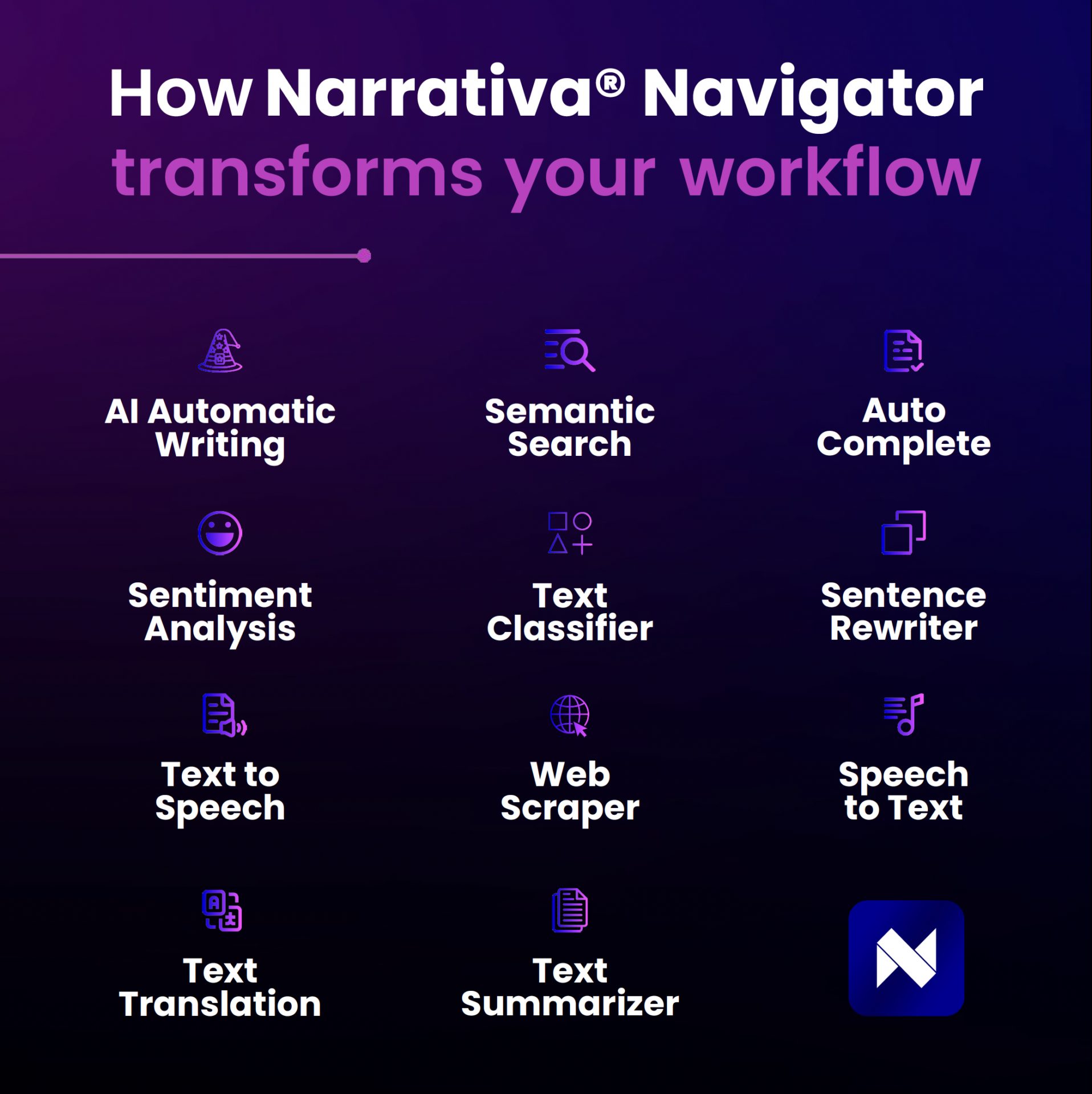
- AI Agents: For Automatic Writing, Advanced Translation, Web Scraping, and Semantic Search.
Ideal prompt structure in Narrativa® Navigator
Use this simple and effective structure:
- Context: What is the purpose of the content?
- Data: Which dataset fields should it use? (e.g.,
#city,#sales_total) - Task: What should the AI generate?
- Format: How should the output be presented?
- Tone / Style: What tone should it follow?
- Restrictions: What should the AI avoid (e.g., length, jargon, repetitions)?
Practical template
Context: [Where or why the text will be published]
Data: Use #field1, #field2, #field3
Task: [What the AI should generate]
Format: [Paragraph, list, summary, etc.]
Tone/Style: [Informative, journalistic, technical]
Restrictions: [Avoid repeated values, limit to X words]
Tips for prompt success in automation
- Use data only when it adds real value
- Design for scalability, not one-off tasks
- Avoid ambiguity—be precise
- Break down complex tasks into smaller parts
Why good prompts matter
Writing better prompts means:
- Higher quality content
- Fewer revisions
- More control over output
- Scalable personalization
- A stronger connection between your data and your message
In Narrativa Navigator, the prompt is your invisible editor.
Your data says what’s happening; the prompt decides how to tell the story.
About Narrativa
Narrativa Agentic AI solutions unlock a faster, smarter future for life sciences organizations, helping them to efficiently produce complex, high-volume documentation for regulatory and commercialization workflows. By automating content creation, Narrativa delivers greater speed, accuracy, and consistency—while ensuring full compliance in highly regulated environments.
Narrativa Navigator Platform provides secure and specialized Agentic AI-powered automation features. It includes complementary user-friendly tools such as the Medical Authoring Companion for CSR and Protocol generation, BioStat Developer for AI Agents for TLF generation and SDTM and ADaM dataset generation, Narrative Pathway, and Redaction Scout, which operate cohesively to transform clinical data into submission-ready documents for regulatory and commercialization. From database to delivery, pharmaceutical sponsors, biotech firms, and contract research organizations (CROs) rely on Narrativa to streamline workflows, decrease costs, and reduce time-to-market across the clinical lifecycle and, more broadly, throughout their entire businesses.
Explore www.narrativa.com and follow on LinkedIn, Facebook, Instagram, and X.