

Real-world data (RWD) is becoming increasingly important in pharmaceutical research. Electronic health records, insurance claims, patient registries, and clinical notes provide valuable information about how treatments are used and perform outside controlled clinical trials.
Yet transforming these data into reliable real-world evidence (RWE) remains challenging. Healthcare information is often fragmented across systems, recorded using inconsistent terminology, and stored in formats that are difficult to analyze.
Agentic AI can help bridge the gap between raw healthcare data and usable clinical evidence by coordinating data extraction, standardization, quality assessment, and documentation. However, automation must operate within scientifically validated workflows to ensure that the resulting evidence remains trustworthy.
Understanding RWD and RWE
Although closely related, RWD and RWE serve different purposes.
Real-world data (RWD) refers to information about patient health and healthcare delivery routinely collected from sources such as electronic health records (EHRs), insurance claims, patient registries, and digital health technologies.
Real-world evidence (RWE) is clinical evidence about the usage and potential benefits or risks of a medical product derived from analyzing RWD.
The distinction matters because collecting data does not automatically generate evidence. RWE requires appropriate study design, reliable data, and analytical methods capable of addressing a defined research question.
Pharmaceutical companies use RWE to investigate treatment effectiveness, monitor post-marketing safety, understand disease progression, and support certain regulatory decisions.
However, the quality of these findings depends on how effectively the underlying information is processed and evaluated.
The challenges of turning RWD into RWE
Several technical and methodological barriers complicate the transformation of routine healthcare information into analysis-ready datasets.
Fragmented and unstructured clinical data
Healthcare information is distributed across EHRs, claims databases, laboratory systems, and patient registries. Each source may use different formats, coding conventions, and data structures.
Important information is also frequently buried in unstructured documents, including physician notes, discharge summaries, and pathology reports.
Extracting relevant variables from these sources requires identifying clinical concepts while preserving their original meaning and context.
Inconsistent terminology and data quality
The same clinical concept may be represented differently across healthcare systems.
Standardized terminologies such as SNOMED CT, ICD-10, LOINC, and RxNorm help normalize clinical information, while common data models such as OMOP CDM support consistent analysis across datasets.
Nevertheless, terminology mapping requires validation to avoid introducing clinical inaccuracies.
Missing values, duplicate records, inconsistent dates, and incomplete patient histories introduce additional complications.
Bias, confounding, and traceability
Unlike randomized clinical trials, observational studies frequently involve patients with different characteristics, treatment histories, and healthcare experiences.
Selection bias, confounding, and incomplete data can affect the validity of findings.
Furthermore, researchers must document how source information was transformed into analytical variables. Without adequate data lineage and audit trails, reproducing results or investigating inconsistencies becomes difficult.
These challenges demonstrate why efficient data processing and scientific validity must be addressed separately.
How agentic AI supports RWD and RWE workflows
Agentic AI enables specialized AI agents to perform defined tasks and coordinate their outputs across complex workflows.
Rather than relying on a single model, a multi-agent architecture can connect different stages of data preparation, validation, and documentation.
Clinical data extraction and normalization
AI agents can assist in extracting diagnoses, treatments, laboratory results, and clinical outcomes from structured and unstructured healthcare records.
For example, an extraction agent could identify a treatment discontinuation documented in a physician’s note and associate it with the relevant patient record.
A terminology agent could then propose standardized representations of the extracted information.
These processes require validation, particularly when clinical language includes ambiguity, negation, or conflicting information.
Data harmonization and quality checks
Specialized agents can support predefined data transformation rules and help identify inconsistencies across datasets.
Potential applications include:
- Identifying missing or contradictory clinical variables.
- Detecting implausible dates or measurements.
- Supporting terminology mapping and data harmonization.
- Checking records against predefined eligibility criteria.
- Flagging inconsistencies between structured data and clinical narratives.
For example, an agent might identify a discrepancy between a medication discontinuation date recorded in an EHR and the corresponding prescription history.
Rather than automatically resolving the conflict, the system can flag it for expert review and preserve the supporting information.
Traceability and evidence documentation
RWE studies require extensive documentation, including data source assessments, transformation specifications, validation reports, and analytical summaries.
AI agents can help organize these materials, maintain references to source information, and support the preparation of consistent documentation.
Multi-agent orchestration can also coordinate activities between extraction, validation, and documentation processes, reducing manual handoffs while maintaining human oversight.
The objective is not to replace clinical researchers or statisticians, but to make the underlying data-processing workflows more efficient, transparent, and reproducible.
Why regulatory-grade RWE requires more than automation
Regulatory authorities recognize the potential value of RWE, but the reliability of the evidence remains fundamental.
The FDA’s real-world evidence framework emphasizes the relevance and reliability of underlying data, the adequacy of study design, and the conduct of studies intended to support regulatory decisions.
Similarly, the European Medicines Agency has expanded its work on real-world evidence through initiatives such as DARWIN EU®, which supports observational research using healthcare data.
For AI-assisted workflows, several considerations remain essential:
- Fit-for-purpose data: The available information must be appropriate for the research question.
- Methodological rigor: Study protocols, cohort definitions, and statistical methods must be scientifically justified.
- Reproducibility: Data transformations and analytical procedures must be documented.
- Traceability: Results should be linked to their underlying sources and processing steps.
- Human oversight: Qualified professionals must validate consequential outputs and interpret the evidence.
AI can help identify data quality problems and support predefined analytical processes. However, it cannot independently eliminate confounding, establish causality, or guarantee regulatory acceptance.
Practical example of an AI-assisted RWE study
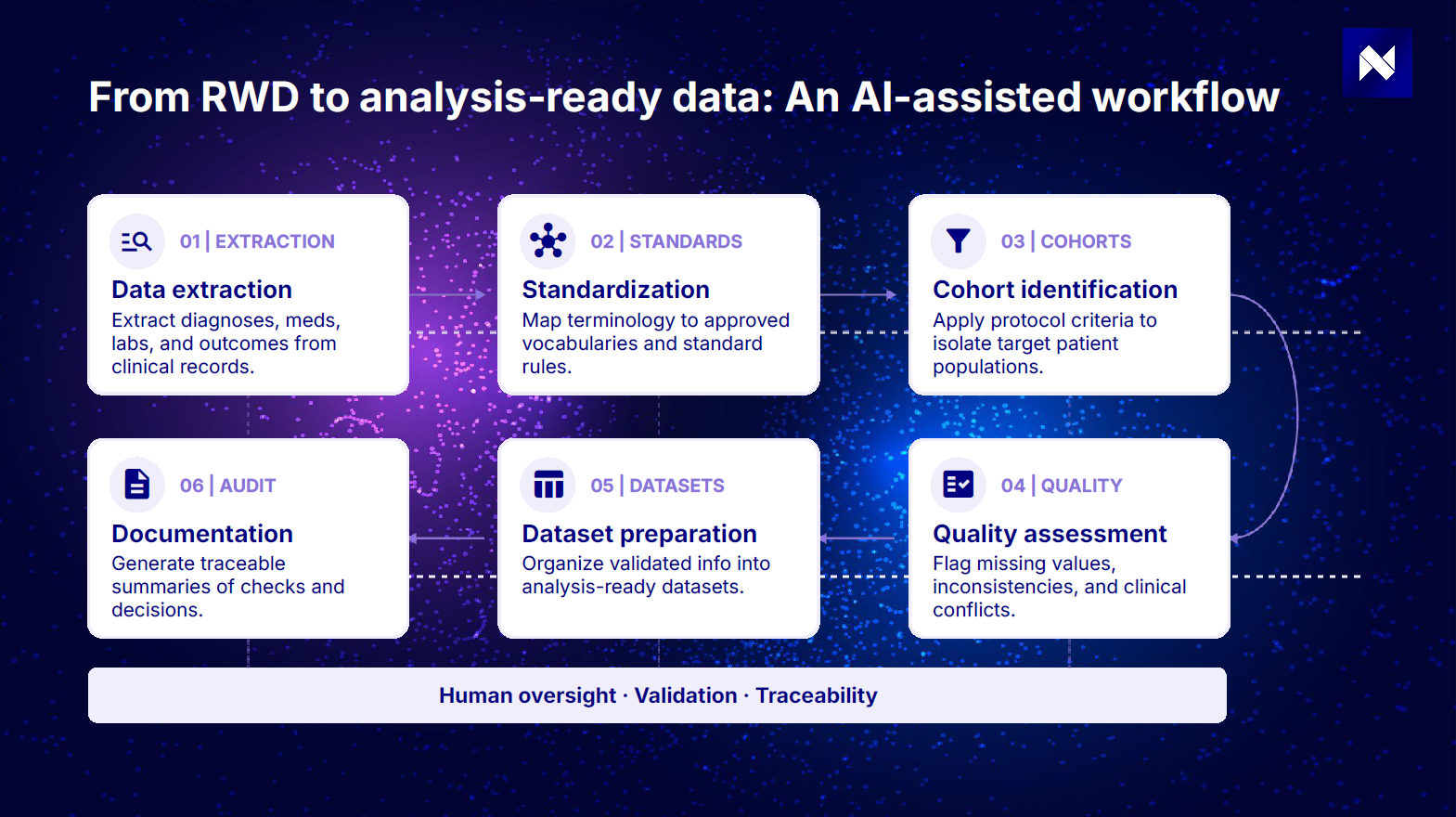
Consider a pharmaceutical company conducting an observational study to evaluate treatment patterns and clinical outcomes among patients with rheumatoid arthritis.
The study combines EHR data and insurance claims from multiple healthcare systems.
A coordinated AI-assisted workflow could support the following activities:
- Data extraction: Identify relevant diagnoses, medications, laboratory measurements, and clinical outcomes from structured records and clinical notes.
- Standardization: Map clinical terminology to approved vocabularies and apply predefined transformation rules.
- Cohort identification: Support the application of eligibility criteria established in the study protocol.
- Quality assessment: Flag missing values, inconsistent treatment histories, and conflicting clinical information.
- Dataset preparation: Organize validated information into analysis-ready datasets.
- Documentation: Prepare traceable summaries of data transformations, quality checks, and review decisions.
Throughout the process, epidemiologists and statisticians remain responsible for study design, analytical methods, bias assessment, and interpretation.
The potential advantage of agentic AI is the coordination of repetitive data-processing tasks while preserving visibility into how information is handled.
The role of Narrativa® Navigator
Narrativa® Navigator is an agentic AI platform designed to automate complex workflows across the Life Sciences industry.
Its capabilities in multi-agent orchestration, document processing, information extraction, consistency checking, and traceability are relevant to several challenges encountered in RWD and RWE workflows.
For example, AI-assisted document processing can help structure clinical information, while automated consistency checks can identify conflicting details across related materials.
Document automation can also support the preparation of structured study documentation and regulatory-facing content, subject to appropriate validation.
Applying these capabilities to RWE processes would require integration with relevant healthcare data systems and validated study-specific workflows.
The opportunity lies in connecting information-processing and documentation activities through coordinated, traceable AI workflows, rather than treating each task as an isolated operation.
The future of RWD and RWE with agentic AI
As pharmaceutical organizations increasingly use real-world data, the ability to process heterogeneous information efficiently and consistently will become more important.
Agentic AI offers a potential approach to connecting extraction, standardization, quality assessment, and documentation within coordinated workflows.
However, its contribution to evidence generation will depend on data governance, interoperability, validation, and scientific oversight.
The future of RWE is not simply about processing more healthcare data. It is about making that data more reliable, accessible, and suitable for meaningful clinical research.
Agentic AI can support this transition by improving the processes surrounding evidence generation, while keeping scientific judgment and accountability in the hands of qualified professionals.
Frequently asked questions
What is the difference between RWD and RWE?
RWD consists of routinely collected healthcare information, while RWE is clinical evidence generated by analyzing those data using appropriate scientific methods.
How can agentic AI improve RWE generation?
Agentic AI can coordinate data extraction, normalization, quality checks, and documentation, helping researchers prepare and validate information more efficiently.
Can AI-generated RWE support regulatory submissions?
AI-assisted studies may contribute to regulatory submissions when their data, methodologies, and processes meet applicable requirements. AI does not automatically make evidence regulatory-grade.
Can agentic AI replace statistical analysis in RWE studies?
No. AI agents can support data preparation and predefined analytical workflows, but qualified researchers remain responsible for study design, statistical validity, and interpretation.
About Narrativa
Narrativa Agentic AI solutions unlock a faster, smarter future for life sciences organizations, helping them to efficiently produce complex, high-volume documentation for regulatory and commercialization workflows. By automating content creation, Narrativa delivers greater speed, accuracy, and consistency—while ensuring full compliance in highly regulated environments.
Narrativa Navigator Platform provides secure and specialized Agentic AI-powered automation features. It includes complementary user-friendly tools such as the Medical Authoring Companion for CSR and Protocol generation, BioStat Developer for AI Agents for TLF generation and SDTM and ADaM dataset generation, Narrative Pathway, and Redaction Scout, which operate cohesively to transform clinical data into submission-ready documents for regulatory and commercialization. From database to delivery, pharmaceutical sponsors, biotech firms, and contract research organizations (CROs) rely on Narrativa to streamline workflows, decrease costs, and reduce time-to-market across the clinical lifecycle and, more broadly, throughout their entire businesses.
Explore www.narrativa.com and follow on LinkedIn, Facebook, Instagram, and X.